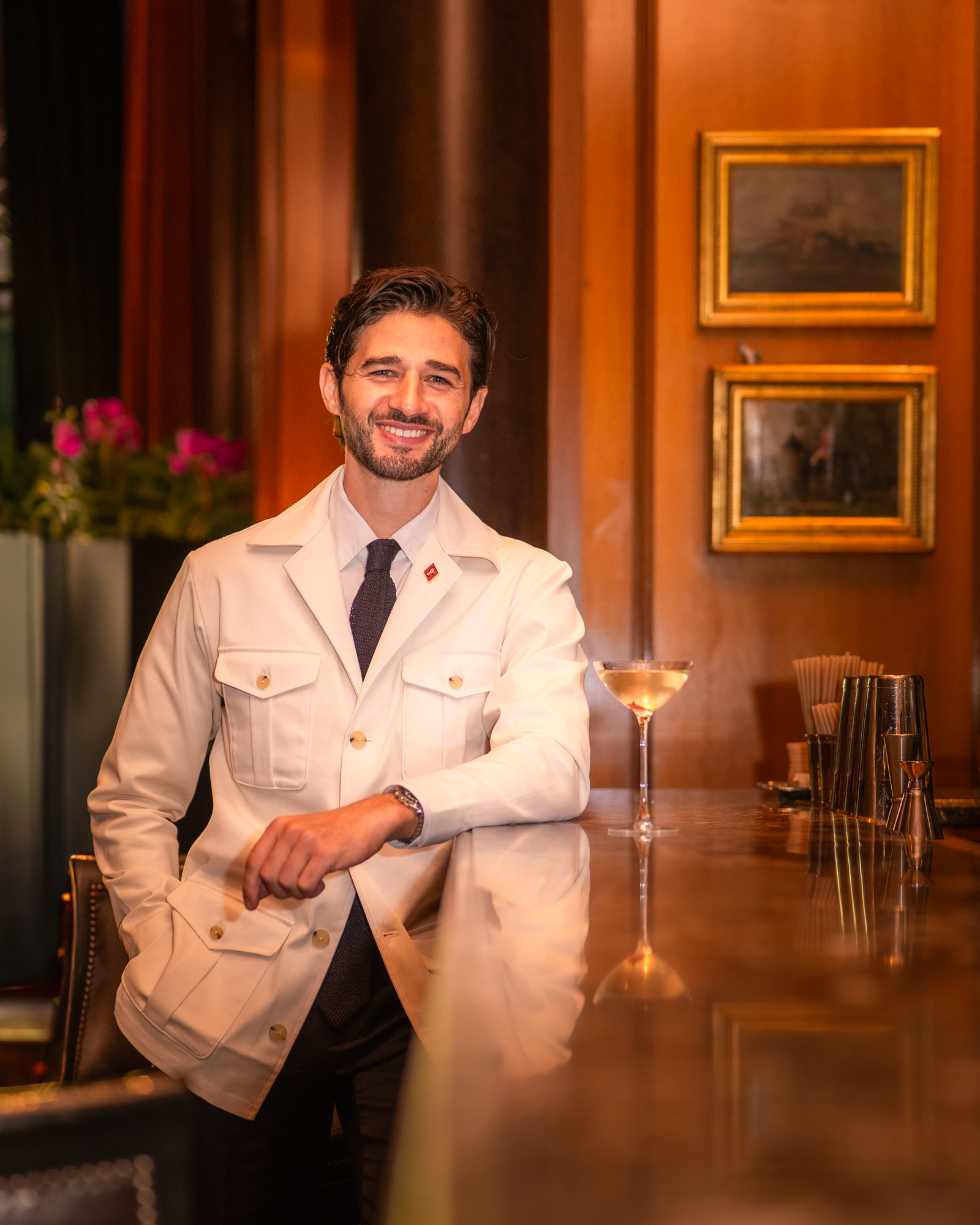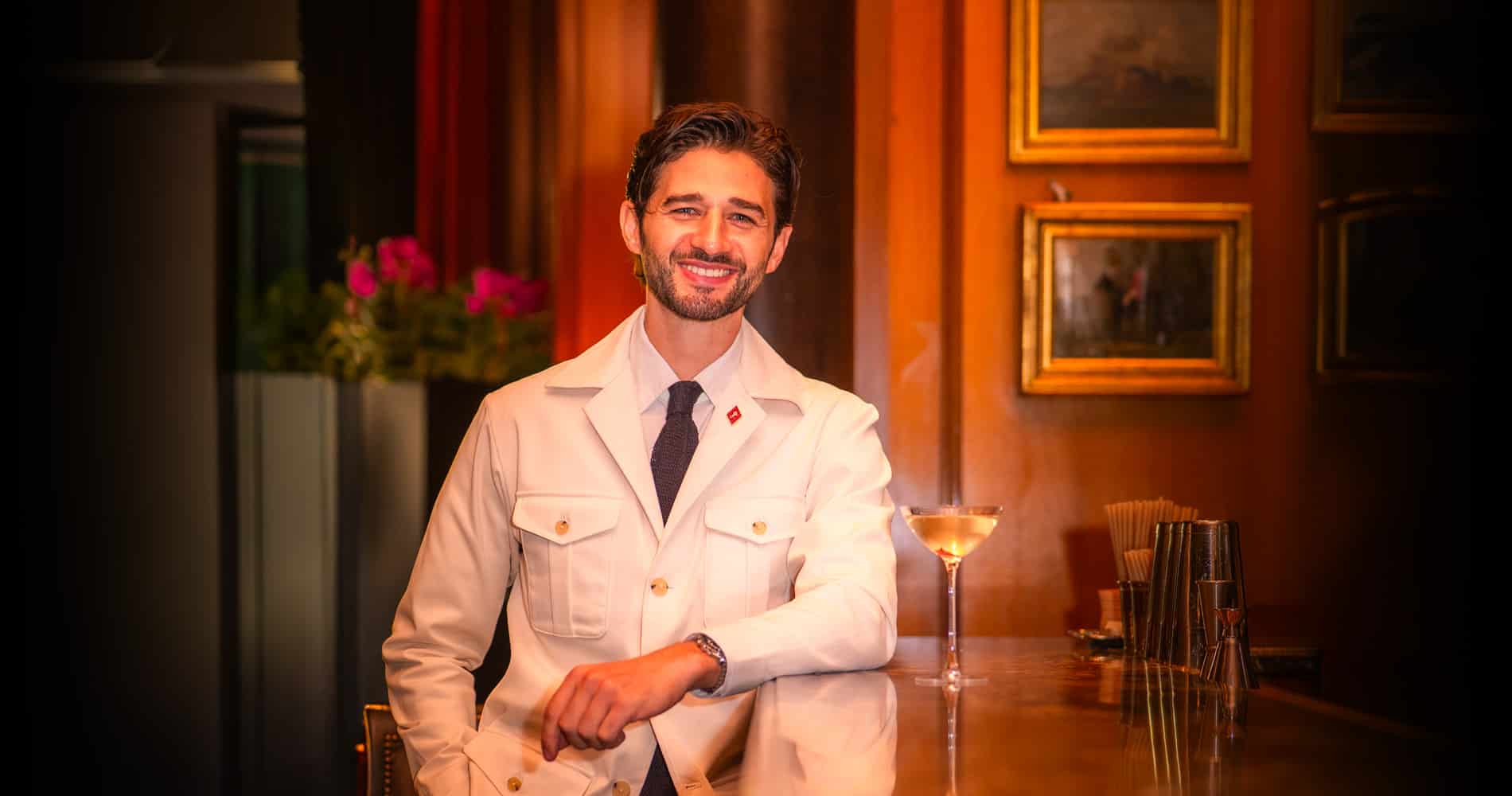
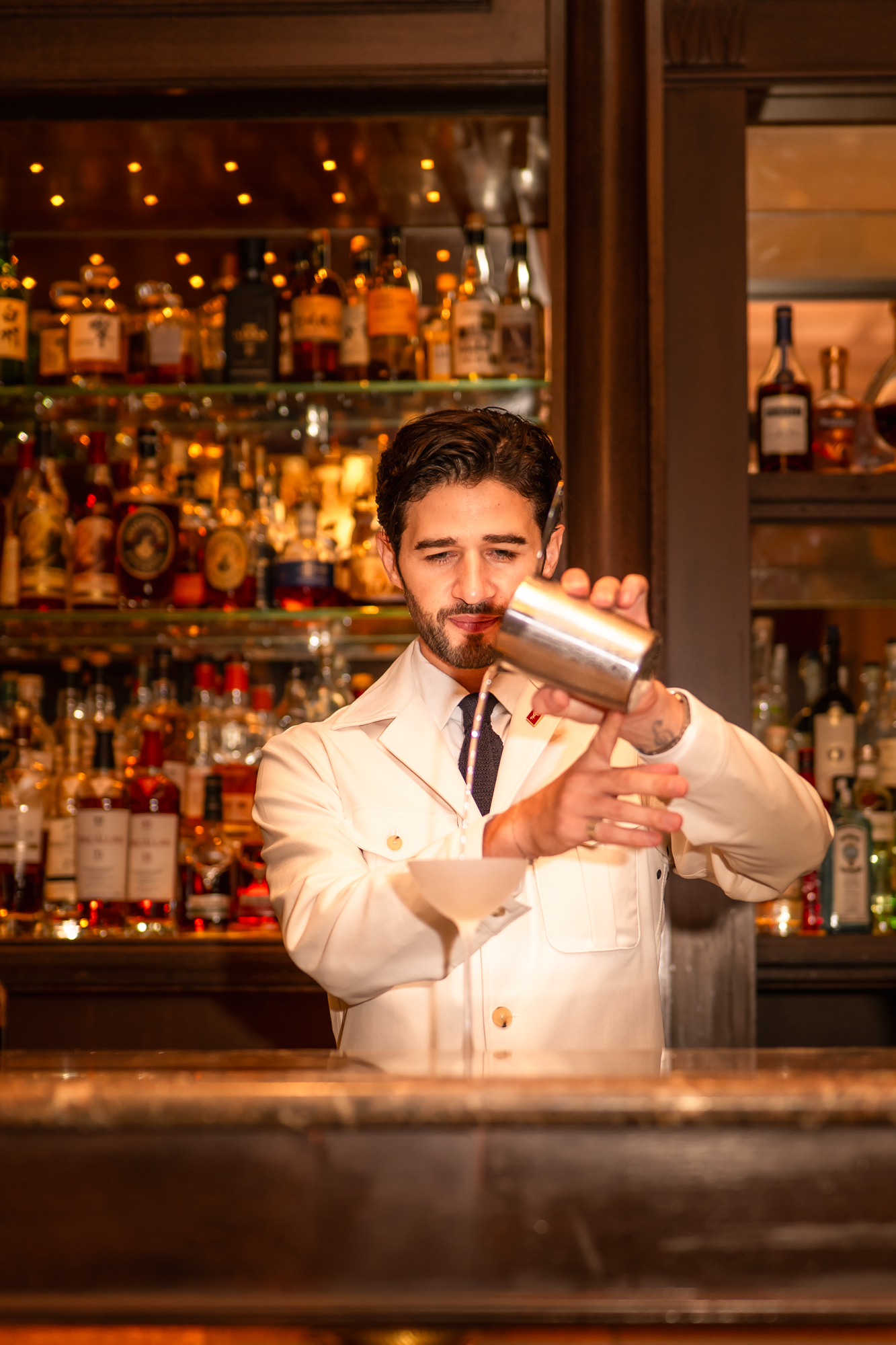
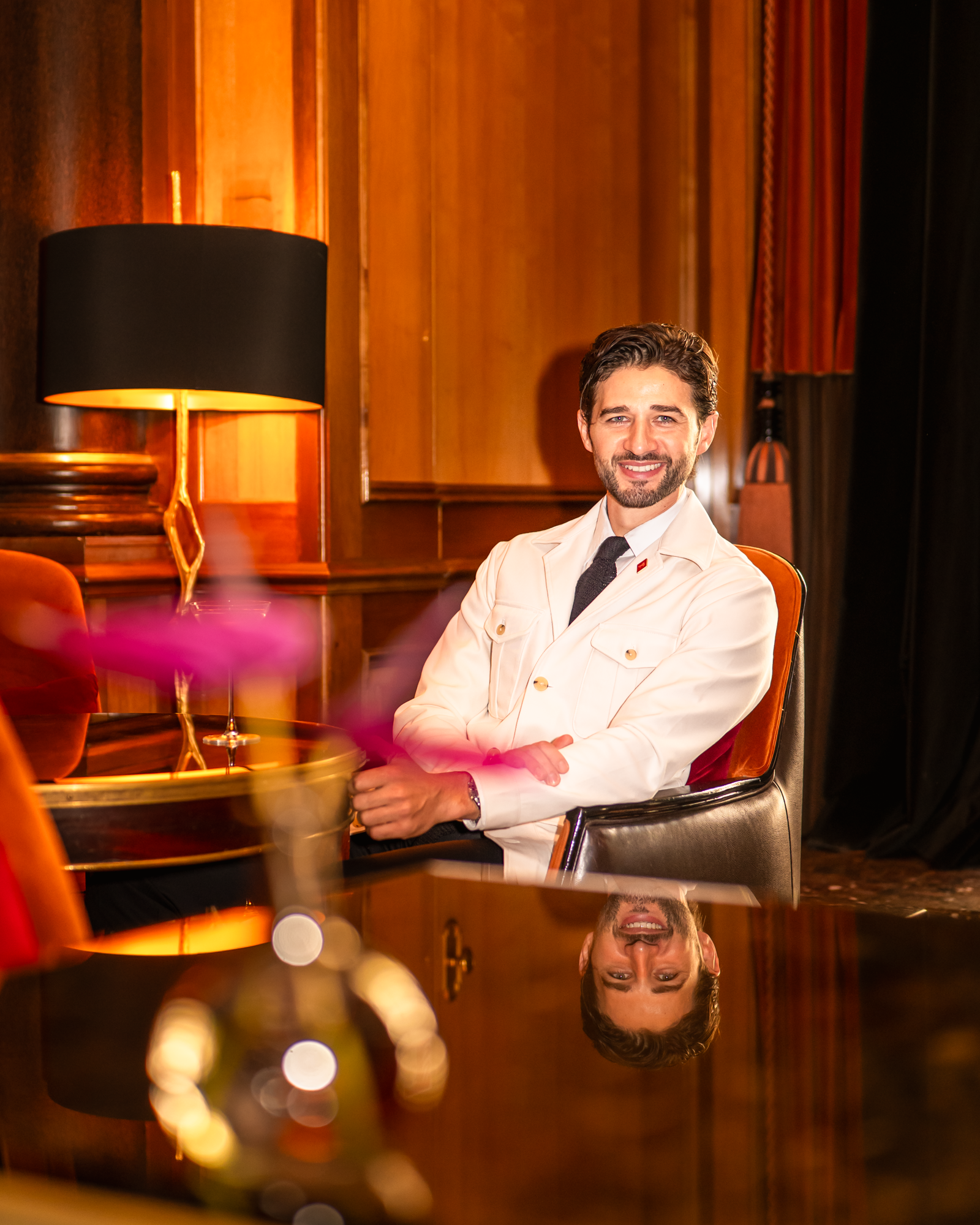
Trained by Alexandre Gauthier, in charge of Danico at its opening, he also relaunched the elevated bar at the Burj Al Arab. Since March 2025, this son of the Opal Coast has been managing the bar at the George V. He has set himself a challenge there: to serve sophisticated cocktails that don’t intimidate customers.
First, there are the olives, placed on the table even before a notebook is taken out. Then a box of matches stamped with a rearing horse, slipped with a “I don’t know if you smoke” that doesn’t really expect an answer. He almost apologizes that the new napkins in the bar’s colors won’t arrive until the next day. At the George V bar, Thibault Méquignon welcomes guests as one would welcome them at home.
Only then, when prompted on the subject, does he pull out his phone. In his notes, a file named “Creation” lists dozens of lines without a single dosage. “Date, salt, vanilla, olive oil.” His thumb scrolls down. “Coffee sabayon, cocoa, agave bitter, cherry, fig leaf, toasted buckwheat.” These are taste memories, noted down immediately after leaving a Michelin-starred restaurant, a brasserie, or a street food stand, whenever a dish struck him. It’s a chef’s notebook, kept by a bartender. All his cocktails are born there. Reading it closely, one also finds the thread of his life.
The planter from the fridge
In Wimereux, near Boulogne-sur-Mer, the family home never really needed a doorbell. His mother, from the West Indies, has a knack for spontaneous hospitality. Between baptisms, birthdays, and friends dropping by unannounced, the table is always full. “We were never safe from someone just showing up. So we always had to have everything.”
The planter (drink) is an institution there, prepared by his mother who starts it two or three days before each celebration to let the fruits macerate. She always prepares too much, and the surplus ends up in the refrigerator in old juice bottles. One morning, the father of the family pours himself a large glass with his coffee, convinced he’s drinking exotic fruit juice. The household derived a rule from this, still in effect: before bottling the planter, remove the labels.
From those years, Thibault retains less a taste than an atmosphere, that of an open door. He also keeps an image, which he would take a long time to use. On Sundays, when lunch stretched until coffee, his father would return from the pastry shop with a strawberry tart and a lemon meringue tart.
The inspiration bubble
Yet, nothing sends him behind a counter. At 18, he went into marketing and drowned in it, “in a world where there’s nothing concrete.” Weekend part-time jobs in a restaurant in his town, taken for pocket money, taught him more than lecture halls: he loves to host. He dropped everything, did a preparatory year, and entered the hotel school in Le Touquet.
Revelation awaited him forty-five minutes from his parents’ home, in the marshes of La Madeleine-sous-Montreuil. At La Grenouillère, Alexandre Gauthier taught him to “respect the product, work it, transform it.” Lacking time to go home between services, the young commis stayed on site. He hung out with suppliers, followed the chef to market gardeners, and sometimes ended up sleeping in the attic. It was the first time he left the cocoon.
A dessert still haunts him: a quenelle of sorrel and fromage blanc ice cream, enclosed in a blown sugar bubble. In the dining room, the server places a white plate, a sorrel leaf, a drizzle of olive oil, then drops the bubble above.
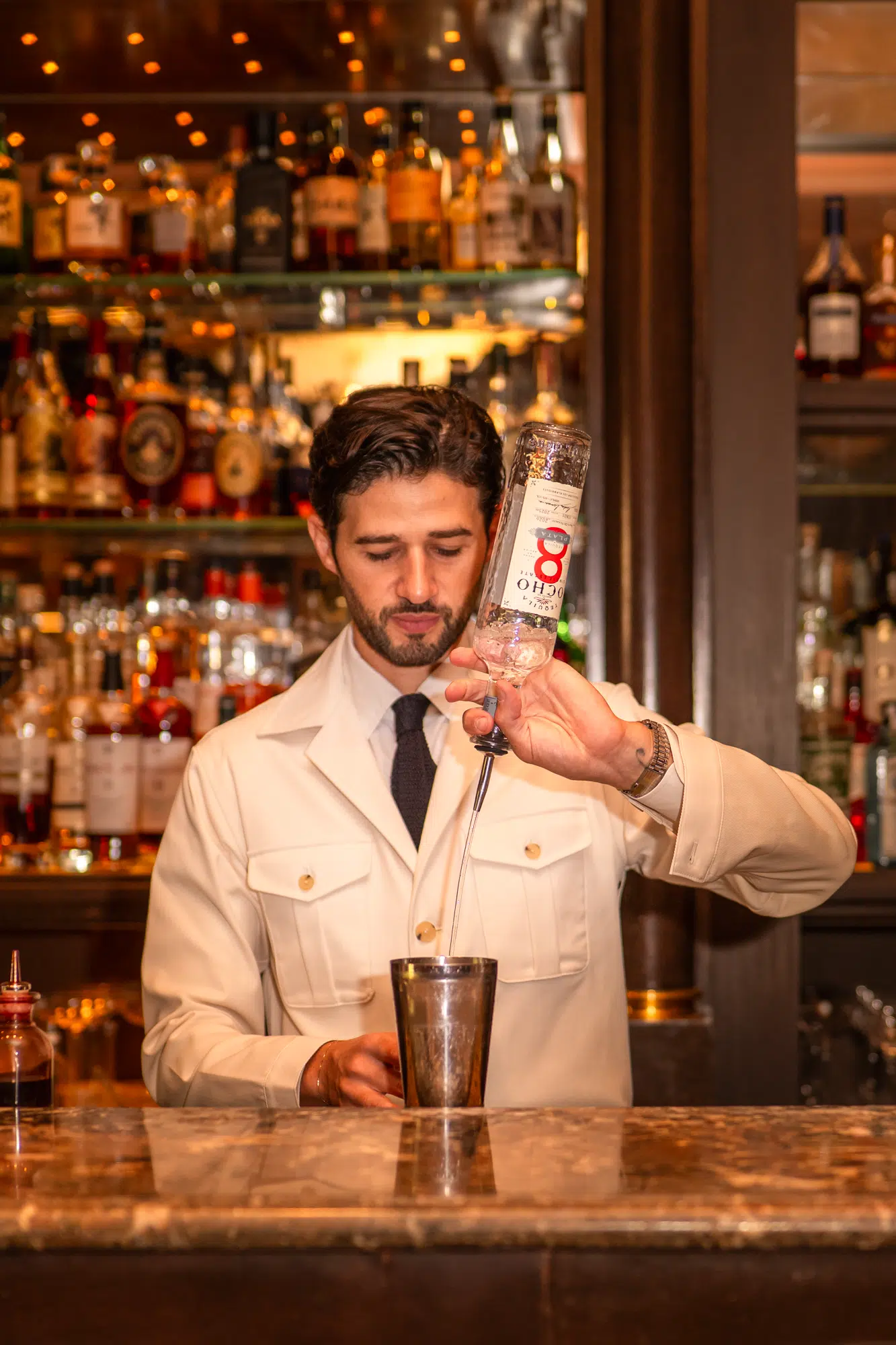
A few years later, behind the bar of the Experimental Cocktail Club in London’s Chinatown, he created a cocktail from it: sorrel, yogurt, lemon, mint, green cardamom. They refused to put it on the menu. He kept it in his pocket. Renamed “Prends l’oseille et tire-toi” (Take the money and run) at Danico, then served in Dubai, the cocktail is now one of the twelve signature drinks at the George V. “I take this cocktail everywhere, like a chef takes his dishes.”
The Keys to Danico
Next came New York, with Nico de Soto, for the opening of Mace. Then Paris, in 2016, for the opening of Danico, in a city still reeling from the attacks. Two weeks after the inauguration, Nico returned to New York and left him the keys. He was 25 years old. “I made mistakes, I learned. He was patient.”
He ran the establishment until March 14, 2020, the evening when the announcement of bar closures forced them to pull down the curtain. He didn’t know he would only return as a guest. Two weeks earlier, he had hired a young bartender, Corentin, whose trial period was threatened. Thibault went to see management: “You must keep him.” Corentin stayed. Today he manages the bar, which celebrated its tenth anniversary with a certain sorrel cocktail on the menu for the occasion.
When Thibault walks through Danico’s door again, he quickly checks the order of bottles on the back bar. Nothing has moved, or almost nothing. At award ceremonies, the team still hands him the trophies. Nico de Soto, who has become one of his best friends, came to taste his new menu a few days ago. His verdict is important because it’s unfiltered. Between them, frankness is an old habit. Towards the end of Danico, Nico would send him “recipes without the recipe,” three ingredients listed, and Thibault would concoct the rest.
The Dubai Adventure
In 2020, he moved to Dubai. Two distributors share the market there, and the slightest niche bottle requires months of negotiations. He learned that a constraint is sometimes better than a full shelf: ‘When you are restricted, you develop your creativity.’ At the top of the Burj Al Arab, he reopened a bar that had been closed for ten months and redesigned everything, from the lighting to the uniforms. At the One&Only One Za’abeel, he has 75 bartenders under his command and creates cocktails with the teams of Dabiz Muñoz and Anne-Sophie Pic.
Travel remains his other notebook. He brings back certainties from it (New York likes sugar, London prefers dry) and a few admirations, such as Gen Yamamoto’s counter in Tokyo, where fruits picked at exact ripeness are silently prepared. He also brings back one failure, and only one, which he admits openly: melon. ‘I love eating it. But as soon as it’s transformed, it no longer smells good, it no longer tastes good.’ In his ‘Creation’ notebook, several melon-themed entries are still awaiting their moment.
Simple, not simplistic
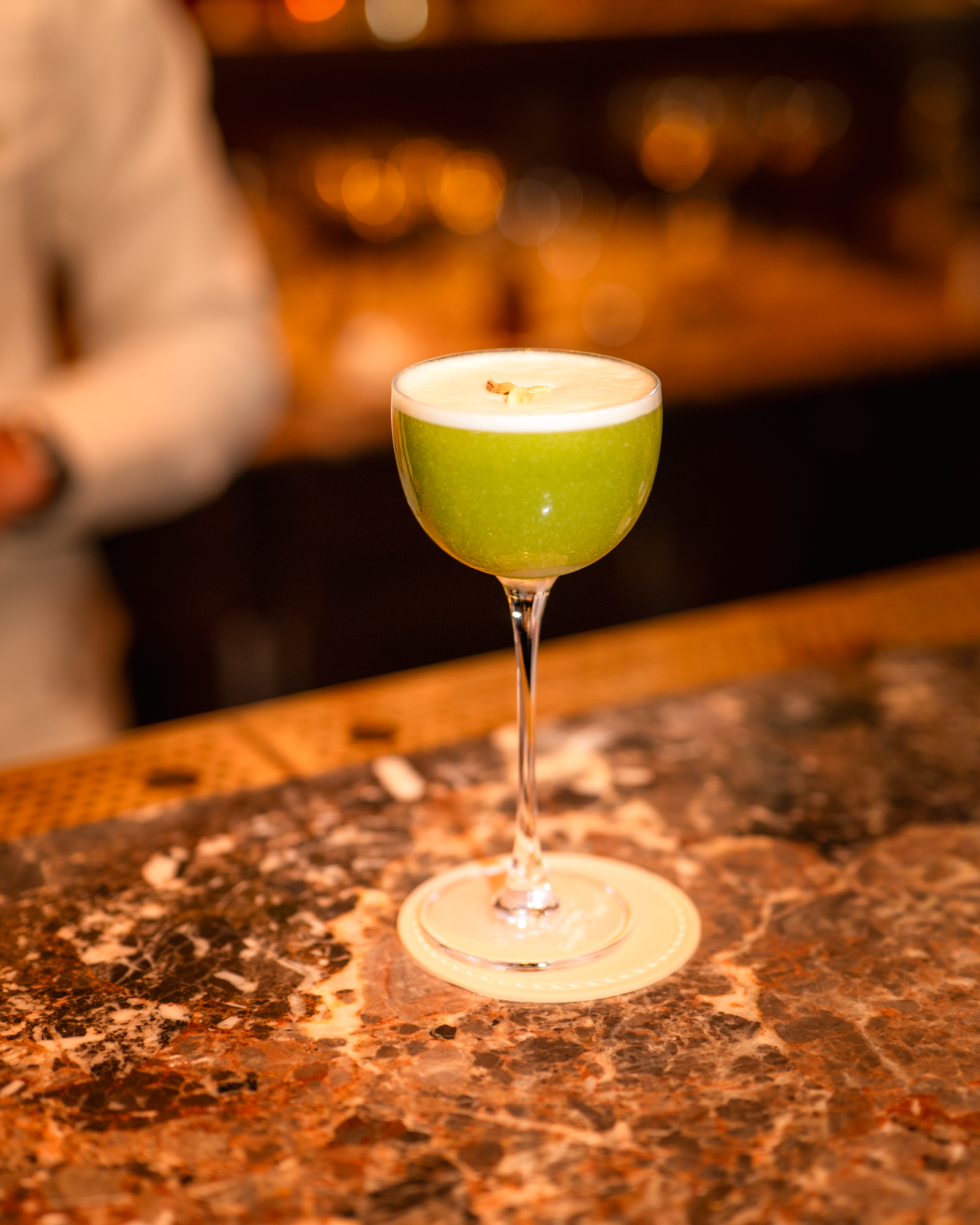
It was inevitable that the Sunday tart would make a comeback. At the George V, it became the Beurre Noisette, a cocktail with browned butter, vanilla, lime, and toasted oats.
In the notebook, everything started with a flavor combination: ‘Butter – Vanilla – Lemon – Meringue’.
To turn it into a drink, he starts by imagining a Gin Sour structure, chosen for its freshness and its balance between acidity, richness, and texture.
The browned butter and toasted oats then undergo a fat wash with gin, to extract their grilled, cereal, and pastry notes while maintaining a clean profile. Vanilla is prepared as a syrup, lemon as fresh juice, while a methylcellulose solution provides the airy texture reminiscent of meringue.
Between the initial concept and the served version, several trials were needed to find the right balance between the richness of brown butter, the roundness of vanilla, and the acidity of lemon. The work primarily focused on texture, with several adjustments to the methylcellulose until a light, stable, and sufficiently airy foam was achieved.
Of all his cocktails, this was the one that gave him the most trouble, due to the foam. Egg white deters some American customers, aquafaba smells of chickpeas, and commercial texturizers don’t suit him. He ended up developing his own formula, based on methylcellulose.
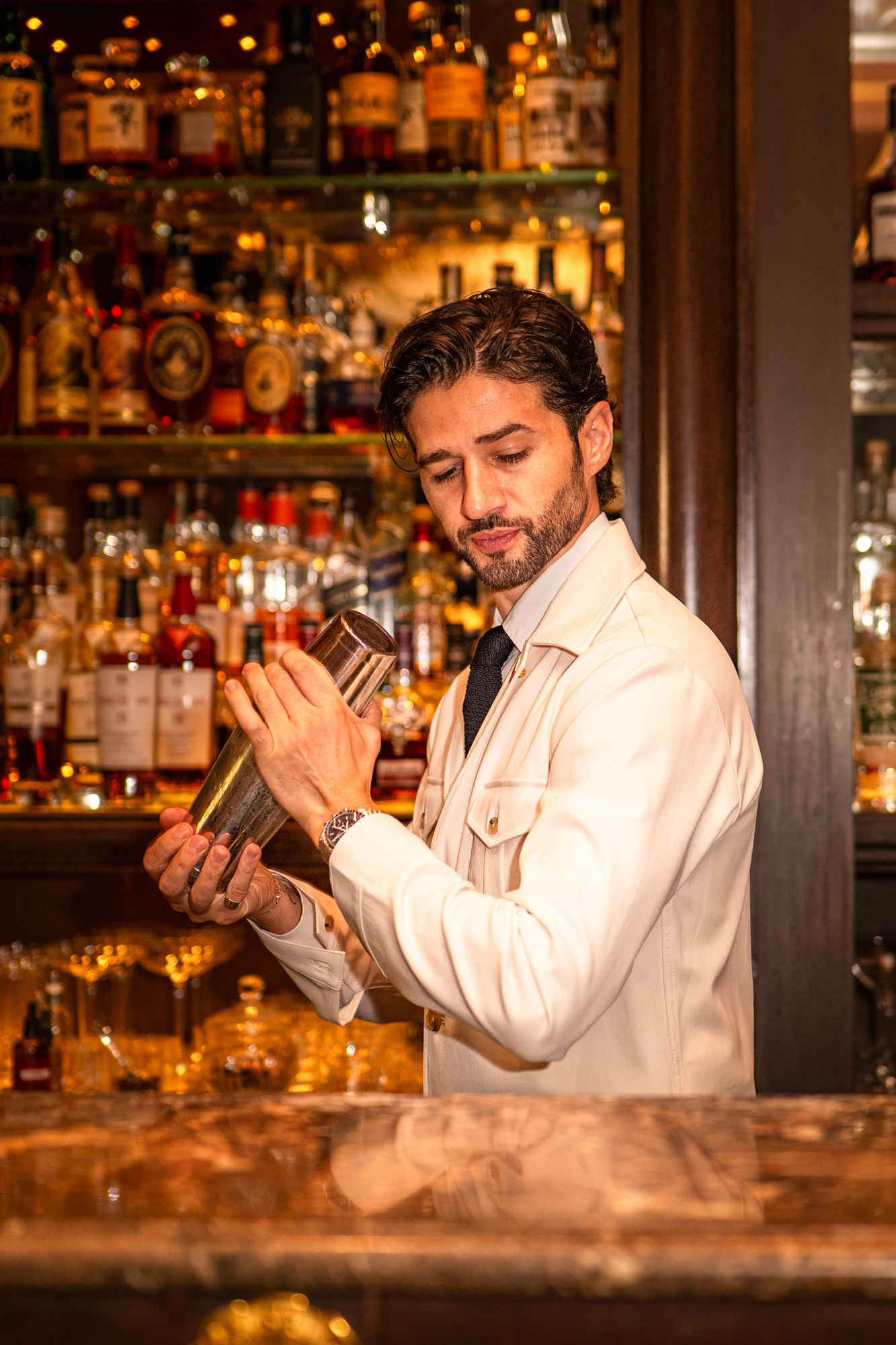
The customer will know nothing of this, and that’s the whole point of what he calls ‘simplexity’. In the lab, beneath the bar, infusions are made, distillation takes place, and sous-vide cooking is performed. At the table, the menu only lists ingredients and a single sentence. The twelve signature cocktails are offered at 34 euros. ‘People come for a business meeting, or after shopping. If you throw technical terms at them, they’ll close the menu and order a glass of wine.’ Simple, he insists, not simplistic. Mixologist? ‘I’m a bartender. I leave the rest to journalists.’ He prefers a phrase inherited from La Grenouillère: ‘I cook liquid.’
A horse, a martini
At the palace hotel, freedom has its limits. Mystery shoppers time the welcome and ensure clients are addressed by name. Changing a 500-euro lamp requires a file, a budget, and a year’s wait. Thibault sees himself as a project manager, handling purchasing, human resources, and finance. The bar isn’t his, but he’s allowed to run it ‘as if it were my own’.
His first project was the name. Weeks of meetings eventually led to an obvious conclusion: ‘People will continue to say they’re going for a drink at the George V bar.’ So, it will be Le Bar du George V.
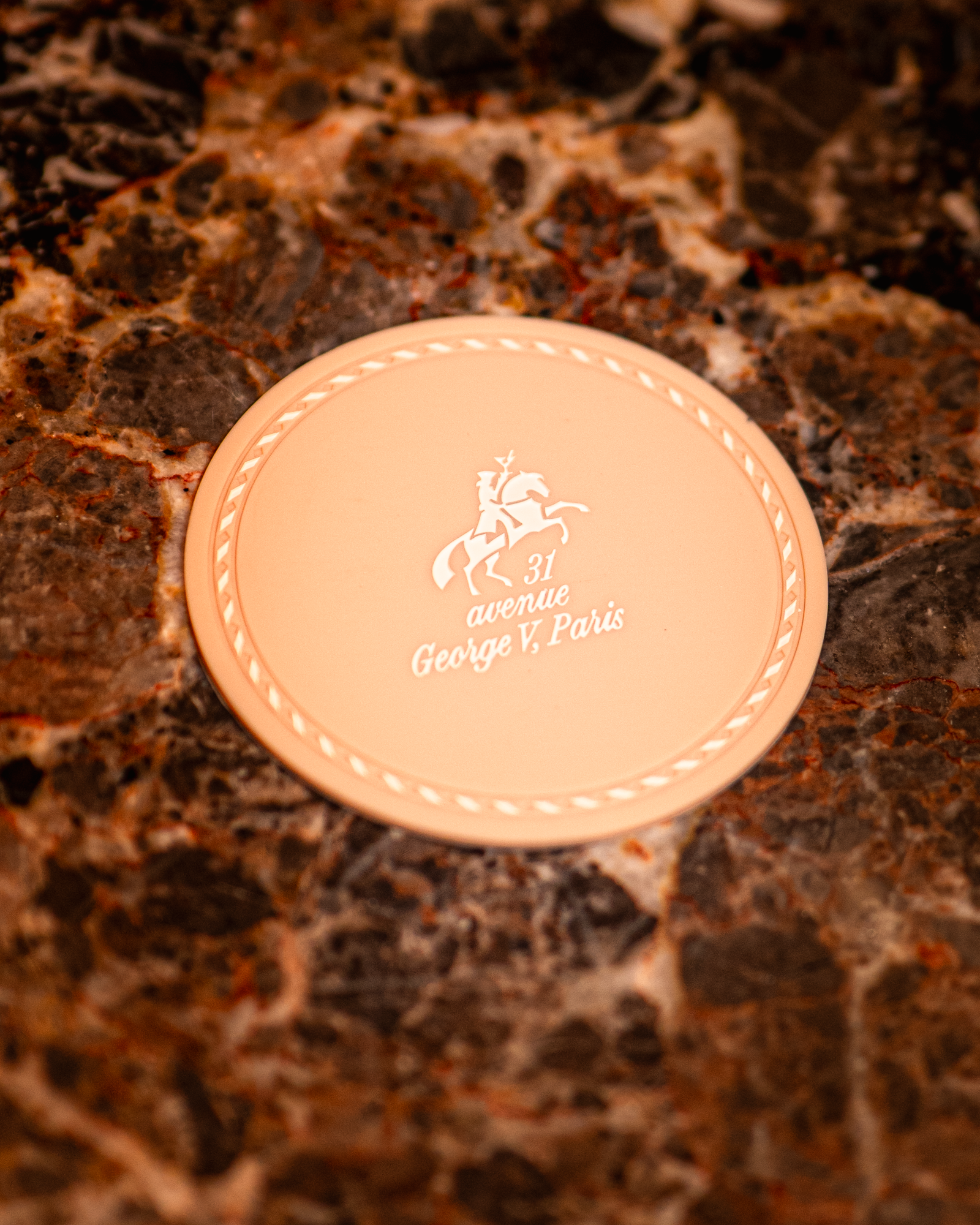
For the logo, all that was needed was to look at the walls. The room, designed after early 20th-century gentlemen’s clubs where horse racing and betting were discussed, is populated by horses. The agency chose a painting hanging near the door, featuring the Marquis de la Ferté on his rearing steed, and slipped a martini into his hand. The horse now gallops across coasters, matchbooks, and the team’s jackets, which they wear ‘with pride’. The parquet frieze pattern runs along the menu. After ‘a long battle’, the bar even got its own Instagram account.
This menu and these structural changes are only the second phase of a three-phase plan. The next stage, next year, will involve the room itself, located in a 1928 building that survived the Occupation and multiple owners without ever ceasing to be a hotel. What will change concretely? Thibault prefers to leave us in suspense.
His days have taken an unexpected turn for someone who knew the 4 AM closings. Coffee, sport, a quiet lunch, arriving around 2:30 PM, and eight hours of sleep. He has formed a team of 9 people who open and close without him. He recruited them based on a question he asks at the end of an interview: would he want to spend an evening with this candidate? ‘Technique can be learned. Hospitality, you either grow up with it or you don’t have it.’ From his profession, he retains a fondness for unconventional timing. He enjoys cycling through a deserted Paris when others are at the office or already asleep. ‘I have the city all to myself.’
The 50 Best Bars? He has worked in award-winning establishments but refuses to make it a goal. « If you aim for the ranking first, you miss the main point: pleasing the customer. » He prefers that one day people say his bar deserves to be on the list. Above all, he wants to dispel a misunderstanding he often hears at the counter. No, it’s not necessary to sleep at the George V to sit there. « It’s also the Parisians’ palace. Come as you are. »
In January, he will become the father of a baby boy. As a child, he learned that labels were removed from bottles. At the George V, he put them everywhere, on jackets, coasters, and matchboxes. The lesson, however, hasn’t changed: at his place, no one should lack anything.