
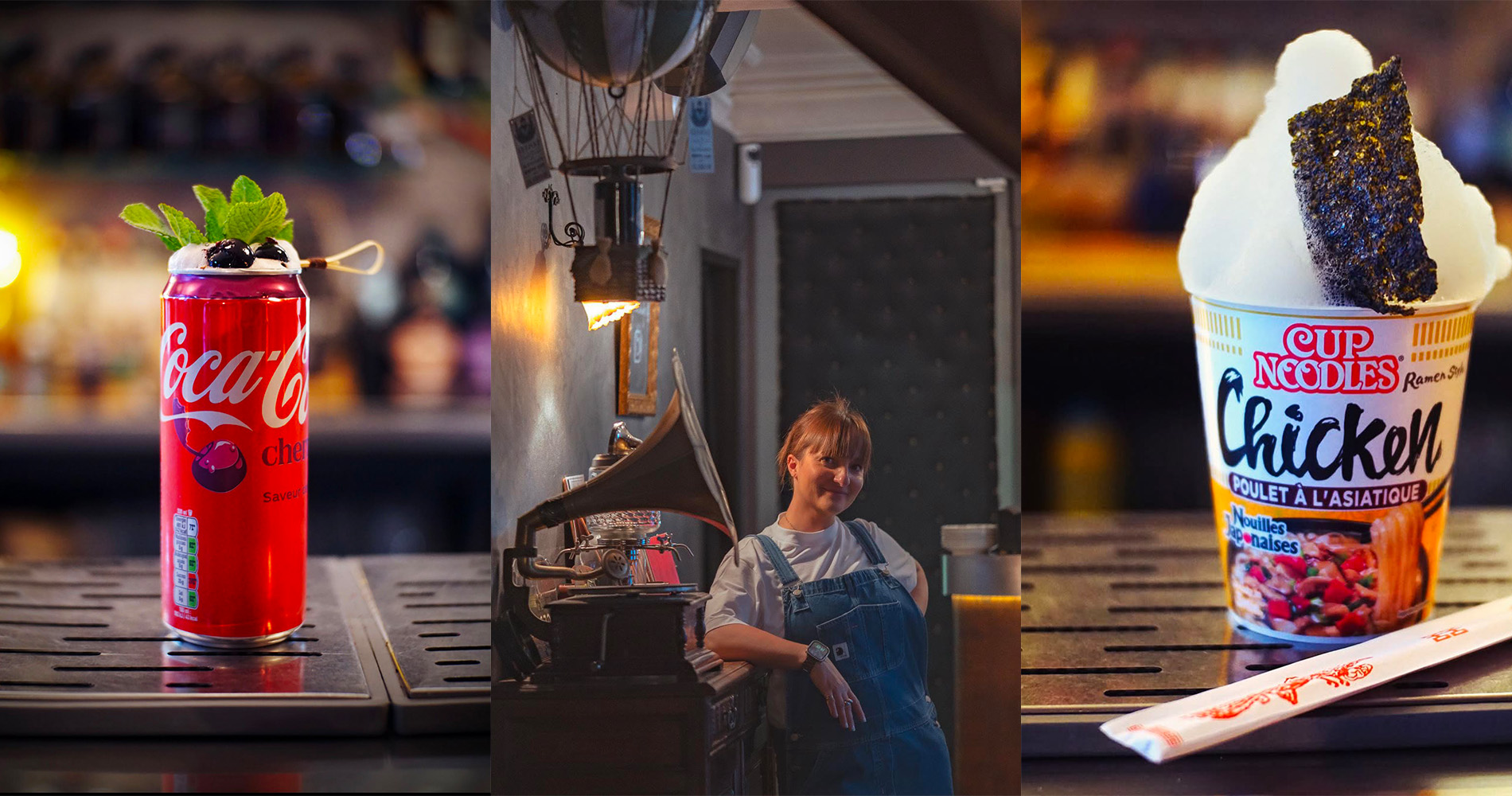
In 2006, she was told that at one meter fifty-three, she wasn’t the right build for the job. Twenty years later, Jessica André has been curating the menu at Le Fantôme de l’Opéra in Lyon for twelve years: sauerkraut cocktail, ramen bowl as a glass, pig cup topped with cotton candy. A portrait of a barmaid who never listened to those who advised her to quit.
“Not the right build”
A short while ago, Jessica found her third-year vocational guidance wishes. Three lines: CAP cuisine, BEP restaurant, complementary mention bartender. “I did it all”, she chuckles. On paper, her path was clear. In reality, every step had to be hard-won.
Several schools rejected her: too short to carry crates and boxes, not built to handle service. Apprenticeship masters declined one after another. A pub-brasserie on Rue Mercière finally accepted her, with a condition set from the outset: no complaining. She quickly understood that she would mainly be cheap labor. For the bar specialization, the training manager didn’t want her either. It was a cooking teacher who supported her application. “I worked twice as hard as others, because I had to prove that I belonged.”
This was followed by a year at the Sofitel with Dominique Del Rizzo, then the seasons. In Courchevel, a bar manager forbade her from going behind the counter, or even touching a bottle to read its label. Coffees, teas, chocolates, mopping. Not the broom: that too, she wasn’t allowed. She left after three weeks. Les Arcs, then Évian, where Romuald De Clement trusted her and taught her management, went so well that a two-month contract turned into a nine-month one.
Back in Lyon. From interview to interview, she was told that they didn’t want a woman behind the bar, or that she should stop immediately. She persisted and secured a three-year position at the Hôtel de la Tour Rose, in Old Lyon, where she ran the bar without having the title. Recruited for an opening in the 6th arrondissement, she saw the business fail in a year, with the owner changing concepts almost every week. Economic redundancy, then two years without finding a job.
The turning point came from extras at Le Fantôme de l’Opéra. When Marilou, the resident barmaid, announced her departure for Australia, she hinted to Julien that she had someone in mind to replace her. Julien replied that he had already chosen. They were thinking of the same person. He called Jessica that very evening, and the job offer was signed the next day.
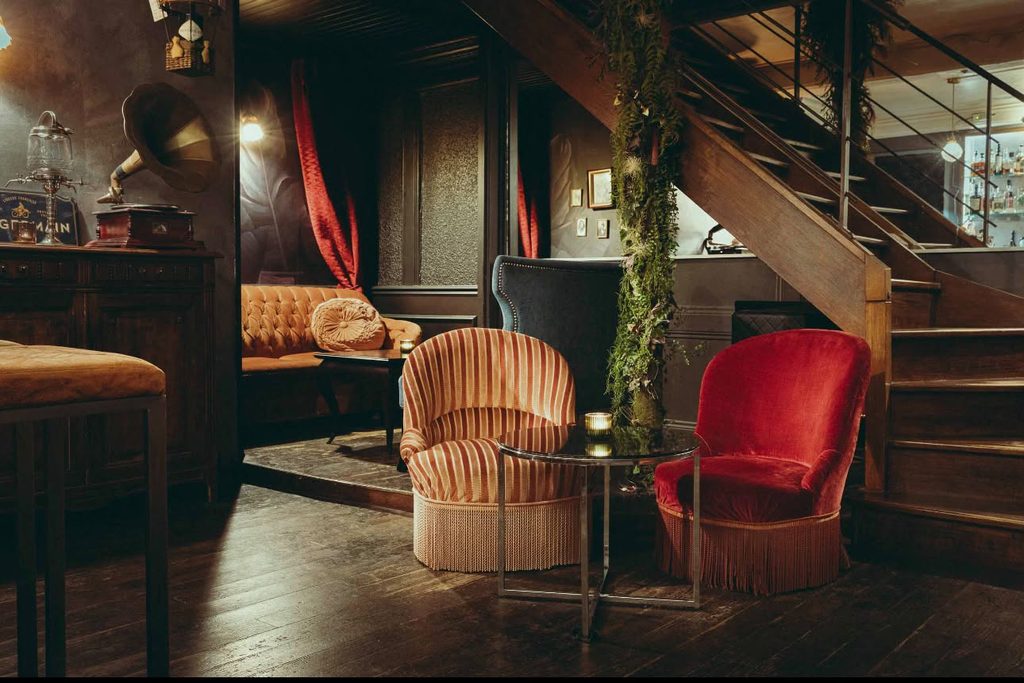
A ‘quirky, limitless’ cocktail bar
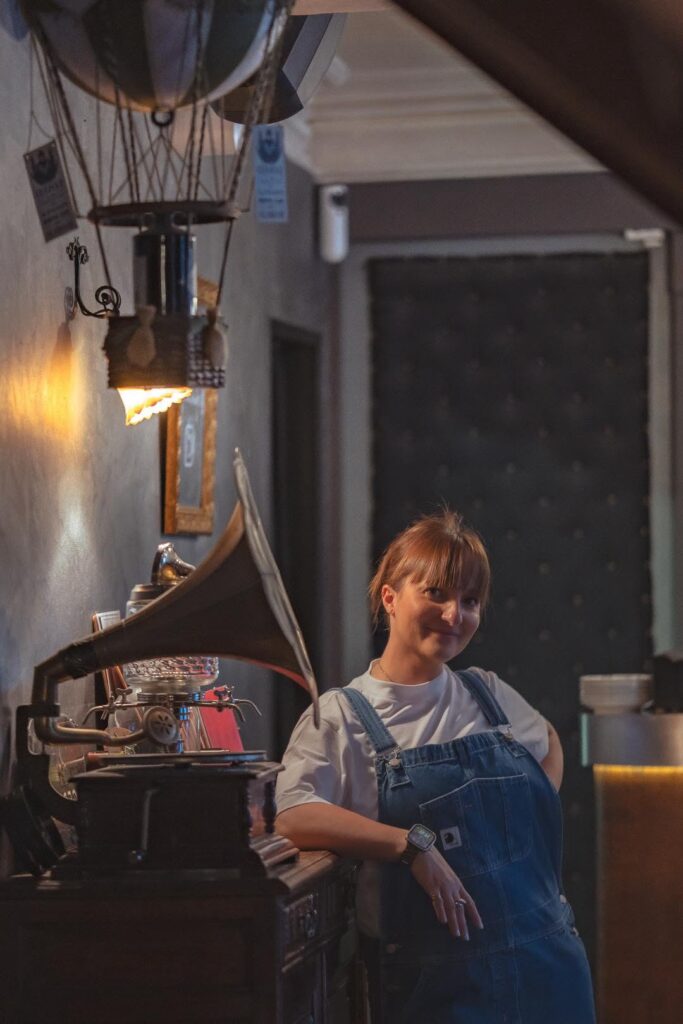
This is how she describes the place. Le Fantôme celebrated its fifteenth anniversary in July. Along with La Mère Brazier, it is now one of the two oldest establishments on the street. Cocktails account for most of the evening sales, ahead of tapas and whisky, at 13 to 14 euros per glass. The clientele mixes loyal Lyonnais locals, regional visitors, and tourists who return every time they visit. Some customers from her very first shift are still there. ‘I’ve witnessed their family evolution.’
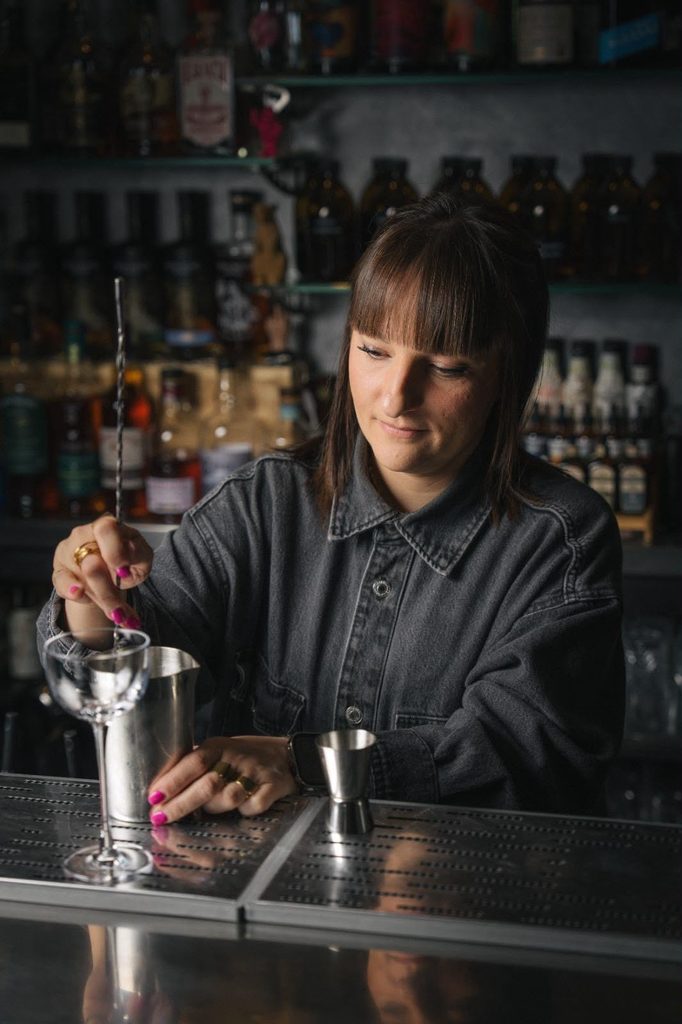
What kept her there for twelve years: the carte blanche. Julien comes up with the names, Jessica handles the recipes, glassware, and presentation. ‘They’ve followed me in my quirky whims for twelve years.’
The menu changes every three months, with eight new creations. Some regulars come twice a week; boredom must be avoided, and a cocktail about to disappear remains the best reason to return. The construction follows fixed rules: a different base spirit per cocktail, at least two ‘pop’ recipes, one intermediate, and the rest for experimentation. By ‘pop’, Jessica doesn’t mean sweet, but reassuring benchmarks: ‘The customer thinks: I know this, I know I won’t go wrong, I’ll go for it.’ She also makes a point of reminding: contrary to its reputation, Le Fantôme serves a lot of dry cocktails.
The autumn menu, released early October, illustrates this wide range: an Espresso Martini variation with sake and miso, a cocktail with spirulina and cherry blossom, another with Guinness and peanut butter. On the ‘pop’ side, Mon Boule te chamboule, combining vodka, blueberry, muscat, and aloe vera, all clarified with vanilla Yop. The surprise comes from a highball with mezcal, nori liqueur, Thai bitters, and purple shiso soda. ‘I really didn’t think it would work.’ Yet, it’s been the most ordered since the menu was released. Jess sees this as the result of an Asian influence cultivated since her beginnings at Le Fantôme, when she spent entire afternoons in Asian grocery stores looking for ideas. A sake cocktail has been permanently on the menu for ten years and remains one of the best-sellers.
Sauerkraut, syringes and cotton candy
The sauerkraut cocktail was born from a joke. Every year, the team has its year-end meal at Brasserie Georges, and every year, Jessica and Julien order sauerkraut. One evening, an idea thrown out jokingly at the table became a project. The encounter with the Gabriel Boudier house and its mustard liqueur did the rest. Added to the menu “with reservation”, it stayed there for three months and sold well, driven by curiosity. Neither savory nor sweet, it clearly divides opinions: you love it or you hate it. Jess mainly remembers one validation, that of a few Alsatians. Next step, this winter: a raclette cocktail.
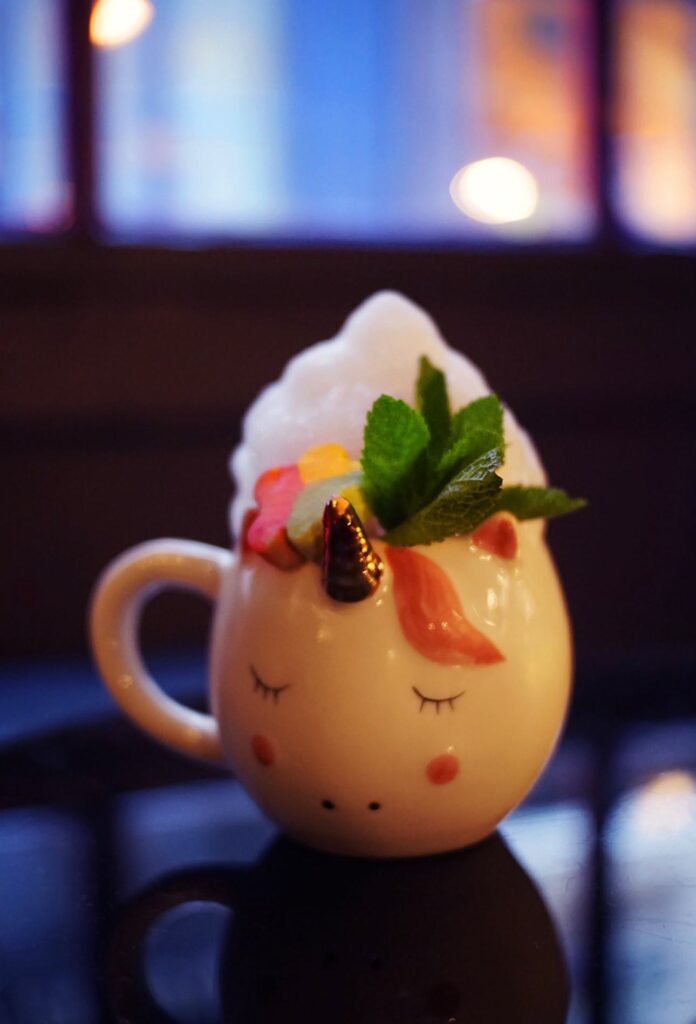
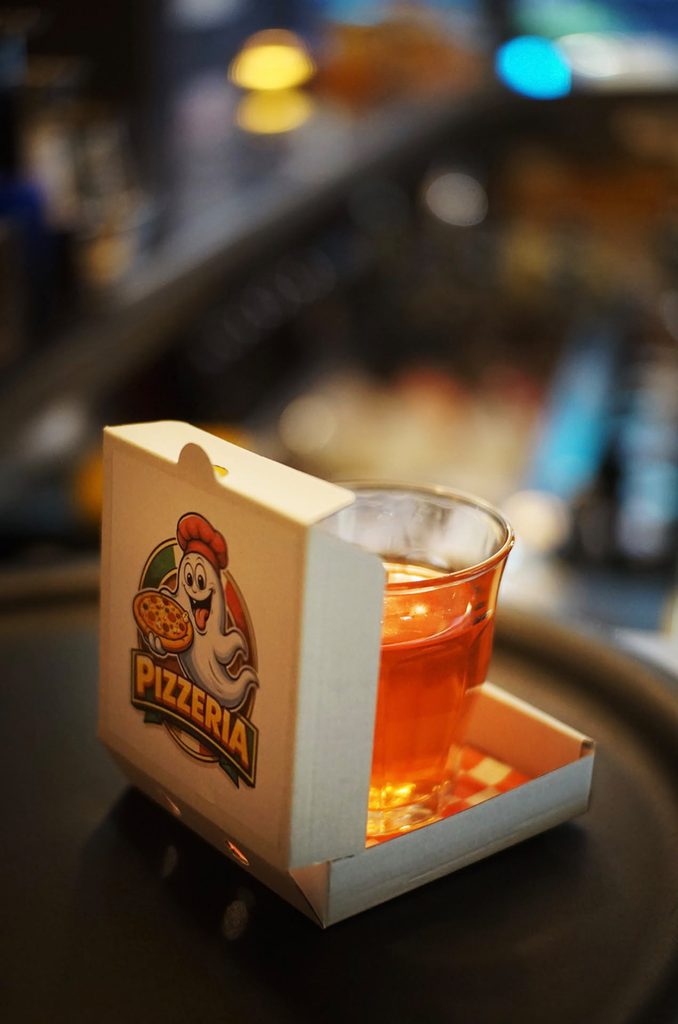
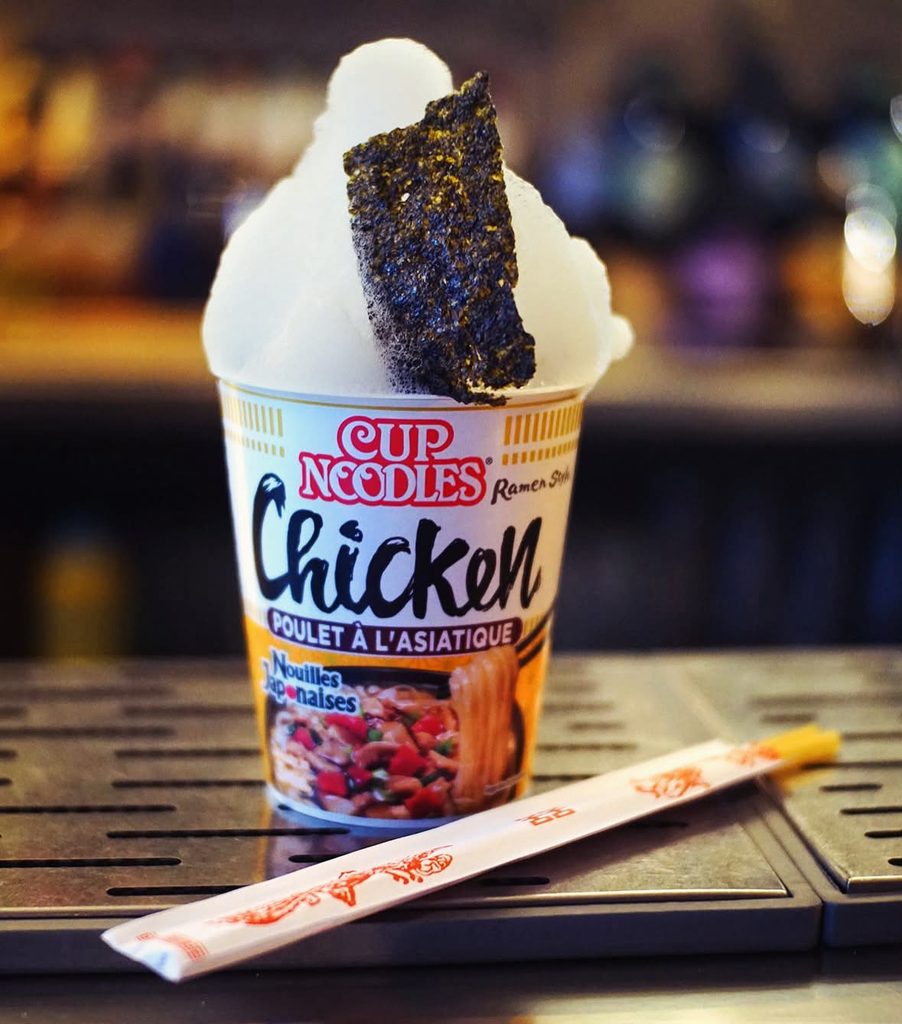
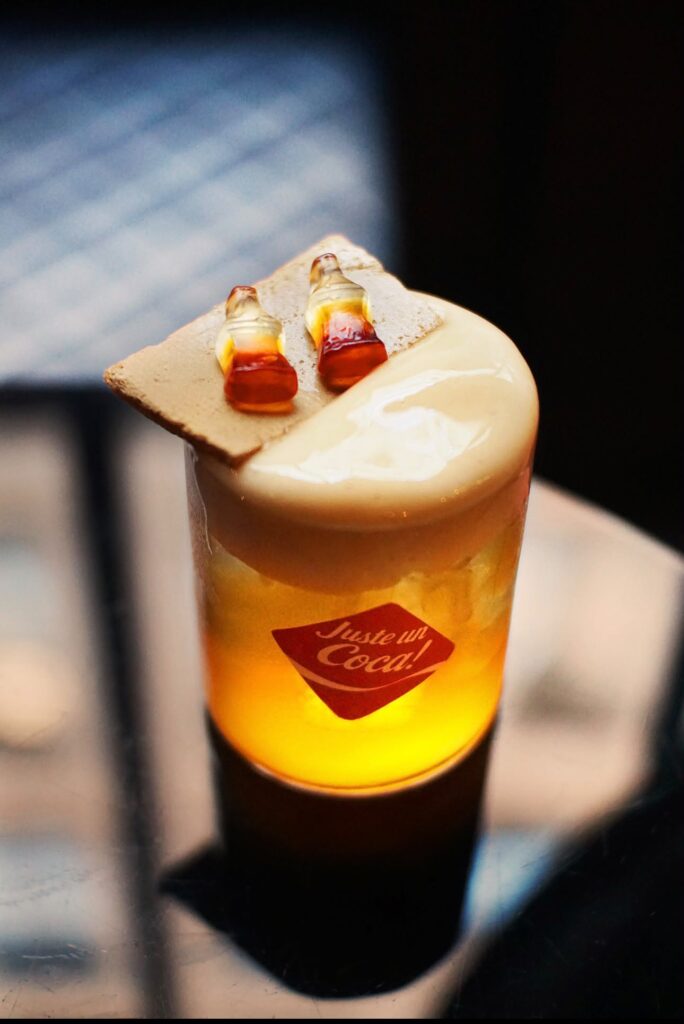
She embraces her reputation as a “garnish pro”. Her reasoning: “People are going to spend 14 euros on a cocktail; they need to experience something when the glass arrives.” Examples abound. A tribute to Shutter Island served in food syringes, with a second absinthe syringe that the customer doses themselves. A ramen bowl cocktail whose straws, slipped into a chopstick case, are first used to tackle the foam. A pig cup topped with cotton candy hair, named “Hussy Alert”. And, during Martin Scorsese’s visit to Lyon for the Lumière Festival, a Wolf of Wall Street with a dollar bill as a napkin and powdered sugar arranged in lines. “I still hear about that one.” The rule: everything must be edible, playful, and no one should take themselves too seriously.
Whisky, cigars and non-alcoholic
Whisky comes to her from her father, who brought back bottles from Scotland and Ireland and displayed them in the small family bar. Specialized for about seven years, Jessica regularly works behind the counters at trade shows, including the latest Whisky Live. She likes peat, sherry casks, and distilleries like The Macallan, Balvenie, or Glenfiddich. Le Fantôme is an ambassador bar for the Scotch Malt Whisky Society in Lyon, with a monthly tasting and some limited editions sourced through its network. Regarding French whisky, she mentions Domaine des Hautes Glaces and compares the current period to that of gin: some good, some less good, and prejudices still persistent among customers.
In summer, on the terrace, some customers arrive with their cigars and ask her what to drink with them. She then creates a two-stage pairing, whisky or rum, that follows the cigar’s evolution.
Non-alcoholic options are treated with the same seriousness. This summer, a non-alcoholic slushie was a huge hit, and the summer menu featured spirulina or homemade pineapple sodas. « Just because you order a non-alcoholic drink at Le Fantôme doesn’t mean you’ll be relegated to a corner. Sometimes, we rack our brains more over them than over an alcoholic cocktail. » She confidently uses non-alcoholic alternatives, from Lyon-based Sober Spirits to JNPR or Tanqueray 0.0. Recently, a pregnant customer, a gin lover, was able to enjoy her gin and tonic again. An unexpected observation, however: despite an expanded offering, Jessica felt a slight decrease in demand this summer. A personal impression, she specifies, which her associate might not share.
Lyon, the crisis and what’s next
She describes a close-knit Lyon scene, where clients are sent to other places when one is fully booked, and a varied one: the tiki of Pineapple, La Cigale, the festive atmosphere of Soda, the classics of L’Antiquaire, the minimalism of Contrast. But business remains difficult for everyone. The closure of La Baignoire in July, ‘our Lyon speakeasy,’ left its mark on the city. Le Fantôme also feels the drop in attendance, with unpredictable weeks where a Tuesday outperforms a Saturday. ‘Just because it’s quieter doesn’t mean you should relax. On the contrary.’
On the role of women, her perspective stands out. Without denying that there’s still progress to be made, she believes that newcomers today have far more opportunities than twenty years ago, and cites Margot at Combat, Aurélie at CopperBay or Lucie, second in the Top 50 of the French Bar Awards. Being the only woman in a competition is something she has often experienced: ‘People might remember us more easily. It’s up to us to make the cocktail that makes them remember us even more.’ She also encourages Swann, her barmaid, and Louane, her new apprentice, to compete.
She currently teaches for the barman specialization certificate at the school where she was trained, the only active professional on the teaching team. There, she advocates for more modern training and solid fundamentals to counter the technical or hygiene errors circulating on social media. When recruiting, she first looks for motivation, and a bit of lightness: at Le Fantôme, the ‘me first’ attitude has no place.
And to the Jessica of 2006, the one deemed too young for the profession, she would only have one thing to say: ‘Don’t give up, you’ll make it.‘
Alcohol abuse is dangerous for your health. Consume with moderation.
