
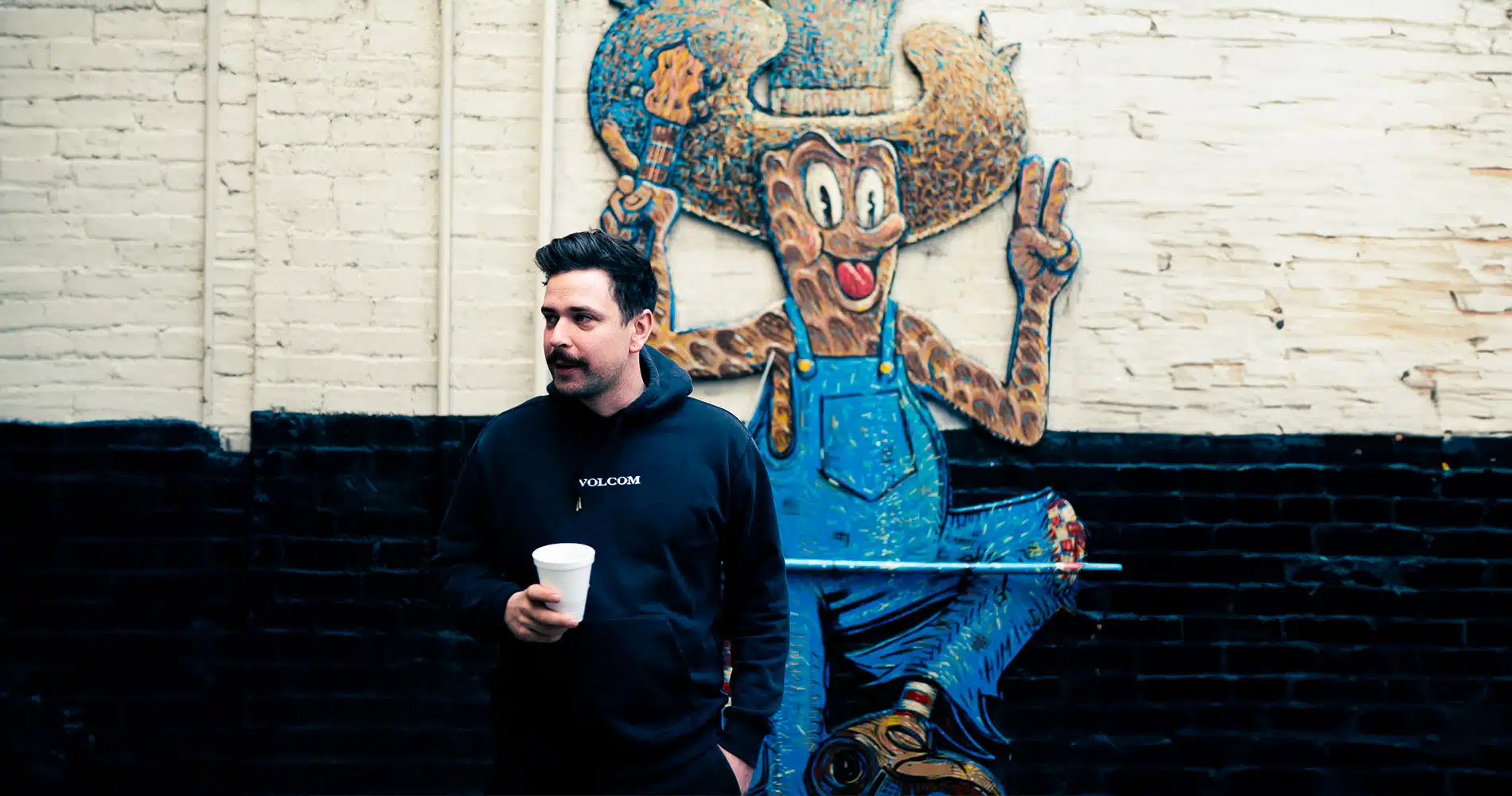
Don’t be fooled by his nonchalance and good nature! Behind this facade, Maxence Piattelli is a workhorse and, above all, a visionary! Today, almost everyone is talking about draft cocktails. He’s been testing, researching, and improving the system for years. A lover of flavors, who doesn’t hesitate to stir things up when necessary. Half-geek, half-artist, now living in exile in London, we wanted to learn more about Maxence, but also about draft cocktails!
What experience made you want to enter the bar world?
I was 15, and there was this super friendly bartender in Crete, at a Marmara club, who did flair bartending. He showed me how to spin bottles. I thought it was really cool. I told myself that one day, that could be me.
The circus always interested me when I was young. I even went to live in Italy when I was 18 with a group of friends to do street circus. We drank more rum than we juggled, but I really liked that. The bar started through that door: a job I could do 35 hours a week, getting paid to juggle in a cool atmosphere.
I came in through the flair bartending door before becoming truly passionate about the taste of things.
And when I came back from Italy, my friends were going out to bars. I’m not the most festive guy on the planet, and being in a bar wasn’t my mood. My idea was to be a bartender to be with my friends, while it was also my job.
Tell us about your journey.
I start as a gardener, then I try to do circus. When I see that it’s going to be complicated, I leave for Haute-Savoie where I wash dishes in a restaurant. I get hired in a bar where I really start serving pints and picons. I can’t believe I’m being paid to do such an easy job. Not that the job of bartender is easy, but I find it really crazy to be paid to have fun. I then return to Nantes to do a CQP at the Henriman Formation school. I am very lucky because there is a trainer, Maxime, who is very talented, who truly gives us the passion for the people behind the bottles and for the way we tell the story of cocktails.
That’s where I become passionate about this profession. I work in Nantes in nightclub bars, but my escape is cocktail competitions. I don’t do them with a desire to win, but truly with an intention to meet other people who also find it interesting to mix things.
I go through the Kit Kat Bar, a Mojito bar in Nantes, with “Mojito Specialist” written in Impact font. Here, I have the chance to have a lot of creative freedom and I work with a team where the guys are fantastic. A war machine, super handsome, super nice, always in a good mood… That’s not me. We also have a super serious guy, very clean and incredibly friendly. That’s not me either.
Me, I’m the creative guy and we do fun things, parties, etc. for two years, then I start a company: Mother Shaker – event bar. This is my first step into entrepreneurship and the first time I do something that represents me with two partners who leave quite quickly. It’s really an experience I cherish, even though it cost me a lot. Covid arrived, and this experience ended.
A feeling of disappointment?
A tiny bit of cash, but mostly, I put my life aside by making my work a priority, and that was really not the right way to do things. I was bound to hit a wall. I lost a lot because there was an incredible person in my life at that time whom I completely neglected. There were quite a few friends with whom you forget to keep in touch… Ultimately, you are never there, neither for your family, nor for yourself.
So, after Mother Shaker, during the lockdown, I joined a company called ICI Lundi, which is a mix of an ecosystem of incubators, accelerators, and startups. For them, I started working in innovation. It was absolutely fascinating. It had nothing to do with the bar world, but we set up a restaurant together called Maison Bagarre. A great opening in Nantes where we really had a lot of fun. We even set up a home delivery service for tartiflettes called “le tire-fesse”.
But I’m still working like a beaver, so my girlfriend leaves. And I go to Haute-Savoie and end up setting up an establishment called Sacrebleu in Morzine, which is my cocktail bar. I was lucky enough that Kyle let me rent his place under management, which allowed me to set up my small business.
Sacrebleu was a bar where we listened to disco and funk quite loudly. We drank cocktails that cost 8 euros and were made with quality products served in record time since everything is on tap. This led me to work today with Yves COSENTINO for the development of draft cocktails and with Charles, for Requin, to build a company where we want to manufacture draft cocktails. For now, it’s for events, but we want to become a keg beverage manufacturer. Guys like Cocorico, for example, have achieved what I consider a great success and a good business.
If Cocorico is the Brewdog of cocktails, meaning people who do good things, I’d like to become the equivalent of Aerofab, a very small brewery near Nantes, which does amazing work. Every time you taste something, it’s too good. It’s expensive, it’s nowhere to be found, but it’s too good.
And I believe that’s what we’d like to do with Charles: sophisticated, beautiful cocktails that tell nice stories, and we can send our kegs to bars that want to serve really cool draft cocktails.
This is our project that is in the pipeline, and in the meantime, we rent draft beer machines for weddings where we put the cocktails. While we build that.
With Yves, it’s about developing draft cocktails, essentially for spirit brands that want to get into draft cocktails. We are here to guide them.
The world of bartending has been moving very fast in recent years; is it better to be self-taught or to go to a bartending school?
I don’t think it’s at all mandatory to go through a bartending school. There are different categories of different bars. If you want to work in a nightclub or a brasserie, I don’t think a CQP (Certified Qualification Professional) will prepare you for that.
But I believe it’s never a bad idea to learn things about a subject that interests you. There are really a lot of training centers in France run by passionate people. I’m thinking of Yoann in Rennes, Maxime in Nantes, the guys from Hypnotique in Montpellier, Thibaut in Paris… People who do this training job because they want to pass on their passion! Getting tips from these people, I think it’s useful, but absolutely not mandatory.
It is necessary to make this profession as simple as possible so that as many people as possible can say “okay, this job is fun, I’ll try it”. We must accept that it is a phase of our life that will last a year, ten years, fifty years, and that all three scenarios are completely acceptable.
Did you have any mentors in your career?
I think Yves is definitely a mentor. I think Maxime Favreau, my first trainer, is really someone who inspired me too. He had quite a crazy charisma. He’s a very humble guy, the kind of guy that’s a bit annoying. Those are really the two who inspired me the most.
Charles, on a daily basis, is someone who inspires me enormously as well.
If you hadn’t worked in the bar industry, what job would you have done today?
If I had been good, I would have been a sign painter. It’s really a profession that I find fascinating. When I grow up, I’d like to do that!
And if I had failed in life, I think I would have rather done what I’m doing right now, which is being a consultant, because it’s very nice, but not as much as being a sign painter.
One could say you’ve had different jobs in the industry. Which one makes you vibrate the most?
Today, I am really very happy to be doing what I am doing. It’s the job that suits me best today. Really, I loved meeting clients, but I’ve kind of moved past that stage.
Trying to help brands with the challenges they face uses creative muscles that I find fascinating. It requires a bit more rigor, but this job also gives me the opportunity to often go into distilleries, to discuss production, to meet the people behind it, people who work at a slightly slower pace which suits me much better.
There’s also a real issue with many bartenders leaving the industry… How do you fix the exodus?
You know what? I think I would rather accompany in the opposite direction, that is to say, how do we make sure that this profession doesn’t become a source of suffering! How do we make it easier for talented individuals who should be taking another path to find it? I find that turnover is very positive in companies, because there’s nothing worse than someone who stays when they’d rather be doing something else.
The bartending profession is evolving at breakneck speed. Restaurants are still open, they can’t find staff? Yes, but somewhere, that’s for the best because restaurants where it’s good to work find staff and receive CVs without any problem.
People who no longer want to do this job need to find pathways. This profession of bartender, barmaid, all professions related to the industry is fantastic because it allows you to develop real skills: you handle your establishment’s communication, your inventory, you have to manage suppliers… By being a bartender, you learn very good foundations, and I think we need to support them in leaving.
So is the era of a head bartender who could stay 20 years, 30 years in the same place over?
If people want this type of career, that’s great for them because there are still companies looking for this type of career. But overall, we are an industry where things move fast, where it’s great that it’s a student job, where it’s great that you’ve been a bartender for two years.
It is really in this spirit that I love the draft cocktail: it really allows anyone to start and learn this trade, and if they wish, to become passionate about what lies behind it. But if this person doesn’t want to learn, no problem, they can just serve and that’s it.
For you, what makes a good bar?
For me, it’s a bar where I’m genuinely happy to have emptied my pockets. I need a place where I can live my own life. I like service that doesn’t interrupt my experience. I like it when I’m offered tastes that are rather simple and that I understand.
I love, for example, Abstract in Lyon at the moment, because they offer me really great things to drink there. Satan’s Whiskers, in London too, because you can read their menu and understand all the ingredients. So, I can take my girlfriend, my mother, my friend, and it will go well. Simple cocktails and simple atmospheres, without too much fuss.
And what was your best experience as a customer in a bar? And why?
Paradiso in Barcelona! We were really blown away because the welcome was incredible. Truly incredible. The cocktails are obviously amazing, the presentations are wild, but the welcome and the attention are always directed towards the customer. That extra hospitality, all the time, everywhere, even though the staff are working incredibly hard. I was blown away.
Hospitality, specifically, do you think it’s something that can be learned? Or is it something innate?
I think it’s generally innate, but it can awaken in someone. I don’t think you can have a process to teach someone hospitality! Hospitality is a feeling that you have to feel, you have to want to please. If you don’t really want to please, then you can only provide service.
There’s a wonderful woman named Anna Dolce who did a TEDx talk about this, called “Service isn’t hospitality,” where she talks about how she trains people in hospitality and what hospitality means versus service.
She says a phrase I love, which is “Service is what you do for the customer. Hospitality is what you do with the customer.”
It must start with management, who must be in a state of hospitality with the team, be empathetic, be supportive, and enjoy the company of these people. This creates a mindset in which you are naturally inclined to be hospitable.
If we deviate a bit to bartender competitions. You recently won the Flavour Master competition. What is your point of view on competitions?
I find them great because they are nice gatherings organized by brands to express one’s creativity. The Mathieu Teisseire one was really enjoyable: there was an experiential aspect where you arrived in the morning, and had an experience throughout your day.
I recommend all bartenders to participate in competitions because it’s a great place to express creativity, and it should only serve that purpose. Competitions should be for exploring creativity, and it’s probably something you do at a stage in your career where you’re exploring. And if you want to engage in creative exercise, there’s no reason not to try them.
The bar industry tends to draw inspiration from and align with the world of gastronomy. Do you see this positively?
It’s a really good thing. When I was a very young bartender, I enjoyed looking at people like Savage or De Soto, admiring what those guys were doing. It’s important to have a profession where there’s media attention around very talented individuals.
This invites dreams and therefore makes the profession more attractive, which also helps recruit talent.
Let’s talk about your projects around draft cocktails. Why did you become interested in the topic?
It started quite early in The Mother Shaker’s journey because we had cocktail hours in events. We had to manage rushes during corporate parties: the founder’s speech, so no drinks are served for 15 minutes. Then suddenly, you have 150 people who just want a drink. They need a drink now! So, draft cocktails were the solution to answer the question: how can I have a cocktail in 4 seconds for moments like these!
At the time, we did a market study. We conducted many interviews asking people what they thought. Does it bother you if I serve you a draft cocktail? Are you willing to pay the same price? Do you see this as a quality product?
The responses were incredibly violent! Everyone told us, “It’s crap, I’ll never pay the same price for it to come out of a tap. To make a cocktail, you need a bartender”… That kind of talk. At that moment, I thought it was a good idea not to get into it…
But when I arrived at Morzine Chez Roger, I put a cocktail in a keg: a Lynchburg Lemonade. It was very good because I had followed the recipe exactly, and there was no room for error, as can happen during rush hours. Customers tasted it and found it excellent. They kept coming back to the bar because I served it in 8 seconds, and the added value for them was that.
Faced with the fait accompli, customers didn’t care at all whether it was served from a tap or if I made it. The important thing was that they could return to their table with their friends and have their moment! Customers come to bars to have a good, convivial time, never to see a technique!
Even I, who am absolutely passionate about bartending, techniques, and products, never go to a bar to watch someone perform a technique. Nobody is interested in that!
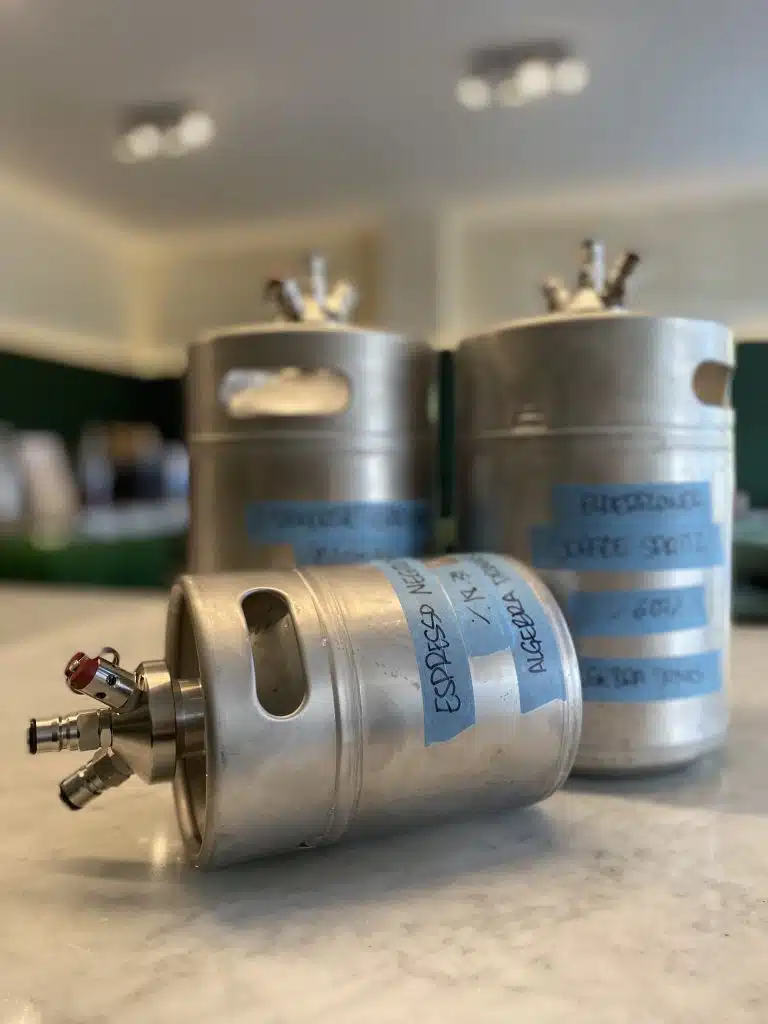
Furthermore, when I launched Sacrebleu, I didn’t have any cash. So it was impossible for me to recruit very talented people, to pay for their apartment, etc. I decided to convert the tap to serve draught cocktails, with the Espresso Martini. Thus, I could hire anyone, but this person would be able to provide a quality experience and not at all worry about the cocktail preparation.
What are the current obstacles to making draught cocktails popular?
Many more bars need to do their job really well on this subject. For me, draught cocktails are a way to guarantee better quality than if they are made by hand. If you serve a cocktail on tap, it really needs to be better than a freshly made cocktail.
There are many people today doing great things (Blue Bird in Paris, Gatsby in Angers, etc.). I think bartenders don’t yet realize how much draught cocktails are a creative tool for them. It’s a tool that allows them to have fun and push the boundaries of what’s possible by truly considering gases as ingredients and using these gases to texture their drinks in a way that is consistent and intentional.
This will change when bartenders realize that this new technique allows them to push their boundaries further.
When you talk to me about gases and textures, I get the impression you have a more scientific approach to this subject. How did you train yourself on this topic?
I won’t hide it from you, I’m a cheat, a sneak. I learned by watching a video, by putting a nozzle on a soda bottle.
I had the chance to work with Stéphane at Bubar, very briefly. He taught me a lot about bottling, carbonation, how things were done conscientiously. It was obviously a real vector for learning.
Then through experience and obviously Yves. But also a lot of artificial intelligence. ChatGPT is a completely crazy resource where it’s good not to take everything at face value. You have to test, verify, cross-reference information. But artificial intelligence has truly been a way for me to learn.
If you start to question the conditions for dissolving CO2 in solution, then there’s little chance you’ll find the answer. Because in reality, it’s a bit barbaric, these are heavy subjects. It’s normal not to know where to look for information.
ChatGPT allows me to lay the groundwork for what’s missing if I want to study CO2, the acidity of liquids, their impact, if you want to study these kinds of things, I use artificial intelligence!
We have a scientific approach in the sense that with Yves, the way we work when we work with liquids is to formulate a hypothesis, test it, observe the results, reformulate a hypothesis, and that’s where science stops. The goal is to arrive at a result that holds up, especially, that is stable and safe.
Many people tell me today that my approach is scientific, but I don’t treat sick children, and I don’t do anything that benefits humanity.
I didn’t think at all that ChatGPT would come up at this point in our conversation…
For example, in building my cocktail with Mathieu Teisseire, I had a creative idea for a flavor combination that I knew would work. But for my storytelling, it was great to be able to rely on a bit of science and to be able to lean on the aromatic compounds found in fennel and watermelon and understand why they go together. So yes, artificial intelligence is a fantastic creative tool.
Regarding draft cocktails, do you think the possibilities are still immense?
I’d love to do things with helium because I think it would be really fun, and we’d have some great evenings! We are really at the beginning of the draft cocktail market. But technically, at least for us, we already know where we want to go today. We know how to make a draft Ramos Gin Fizz, for example, so we know it’s possible.
Yves and I like to say, “if you can think it, we can tap it“. And honestly, it’s not that we’re absolute geniuses, it’s just that it’s not that complicated.
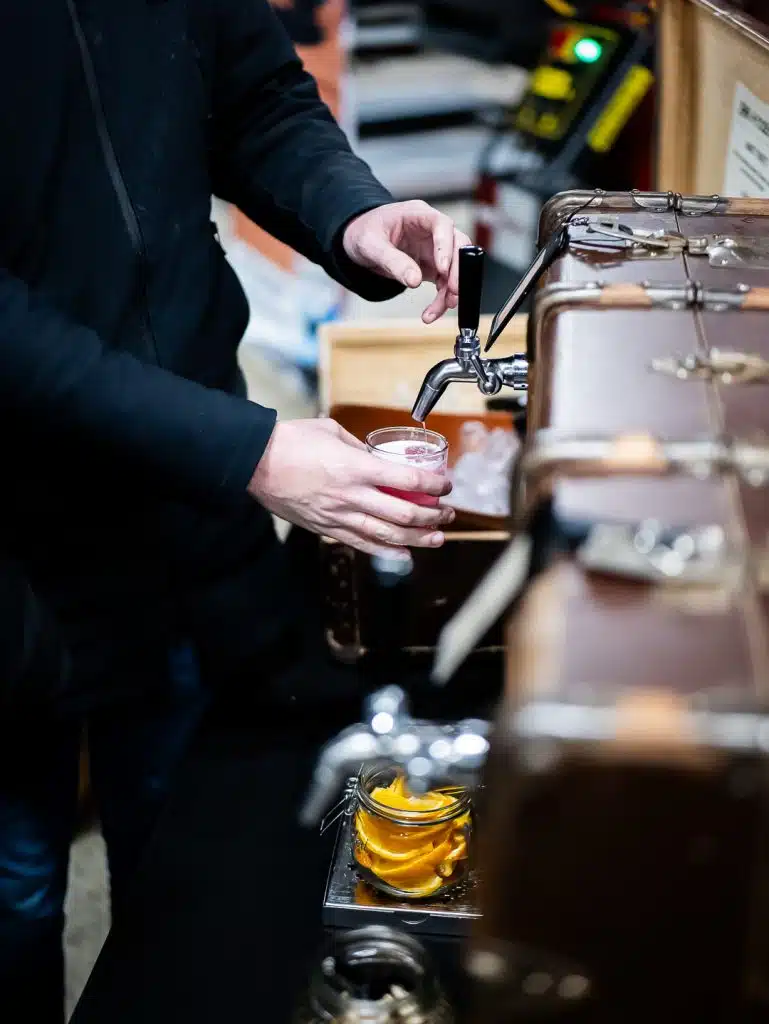
Right now, there are a lot of technological innovations around kegs. There are guys inventing kegs with integrated mixers. There’s Micromatic that invented a kind of magnet that constantly spins in your keg. But all of that is useless! With the equipment we have, meaning the CO2 tank you already have at the bar, a Guinness tap nozzle you’ve recycled from a dispenser, and a keg you buy for 50 bucks on Aliexpress, that’s more than enough. With that, you can already do a lot of things.
For the past few years, cocktail robots have also been appearing…
I sincerely wish to one day drink a delicious cocktail that comes out of such a machine, but I find that there is nothing more anticlimactic than this type of machine.
Sugar is put into pipes that are not used permanently, so this sugar crystallizes, the dosages are messed up, and therefore it doesn’t work.
Generally, these robots are in the hands of people to replace competence. But the problem is that if people don’t already have the competence to make a Cosmopolitan, at what point did we think they would have the competence to maintain a 10,000 euro machine? It’s just not possible, and it won’t happen. But if someone wants to change my mind, I’m always up for it.
Bartenders are still resistant to draft cocktails, what would you have them test to change their minds?
The Whiskey Sour that we designed with Monkey Shoulder. It was truly a great tool to change people’s minds. We had a super creamy texture, just as satisfying as egg white, with a precise aroma. It’s not very difficult to convince people that we can make a Negroni on tap. Adding bubbles to draft and serving a Spritz is the same, it doesn’t impress anyone, even if I find it slightly superior to a Spritz made from a bottle.
On the other hand, emulsified drinks, so a completely creamy Espresso Martini that flows in 4 seconds and is absolutely delicious. A very generously emulsified Whisky Sour… For me, these are things that change minds.
Do some spirits work less well than others in draft cocktails?
I truly believe there’s room for everyone: from cider to quality brandies. The reaction between gases and different spirits is quite interesting, especially how CO2 really brings out woody aromatics.
It’s interesting to know that when you’re going to carbonate an entire drink, perhaps your cognac, your armagnac, or your oak-aged rum, you might want to reduce it slightly because the woody notes will really come through. There’s a rebalancing to be done with certain drinks.
Some believe that draft cocktails will kill the bartender profession. Hearing you speak, it rather suggests the opposite, allowing more time for creativity and hospitality…
Exactly. Today, you’re talking to a 30-year-old bartender who’s a bit lazy and is very happy to spend his day in the lab doing precise, nice things because the preparation side excites me enormously, freeing up time, and allowing me to say that my service will be much simpler.
If you go to Honey moon in Paris, they have 32 draft cocktails. So the guys really have time to be very cool with you. In my bistro, I put the espresso martini on tap because on busy nights, we could make 120! That’s not fun for anyone.
If you had to name one negative point about draft cocktails, what would it be?
That it’s too good and you sell too many. Consequently, it’s annoying (laughs).
In reality, there’s a learning curve. It’s rarely something you’re handed and suddenly, you find the magic formula with it. And above all, by definition, you can’t make mistakes because you can’t change your drink once it’s in the keg.
Someone who knows their drink and tells you ‘I’d like a Whisky Sour with this specific whisky’ – you’re stuck there too because, by definition, the product is fixed. But that’s really because you forced me to find a negative point!
Today, you are based in London. Can you tell us a bit about the differences between the French and English industries?
I’m really well in England. The French industry is very creative. It’s a bit like a Parisian woman. She smokes cigarettes, she wakes up with a hangover, she eats Roquefort with her coffee, and there’s a creative, arty, very cool side.
In England, I find a profession that is very professional. We talk about junior and senior bartenders. People here reply to emails and send us screenshots of their Excel sheets to ask if the recipes are consistent, which is something I see less in France.
The French bar, for me, is truly creative. We do crazy things and push the boundaries of what’s possible. In England, we are very professional. We work, we put twists on classics. From my little window, that’s what I seem to see.
What can we wish for you in the coming year?
More interesting projects. I am lucky to have a job today, whether with Requin or with Yves, where we have a lot of requests and where we are working around a growing trend. I don’t have many doubts that we will have even more work on this.
A word to conclude?
Watermelon works incredibly well with pastis: watermelon syrup, pastis, water, incredible.
Or in an Espresso martini, replace your sugar syrup with watermelon syrup. Fantastic.
Or in a Paloma, just a touch..
We absolutely must talk about watermelons. Watermelon mixes very well, and its habitat must be protected.
Many people confuse watermelons and hummus. This is a mistake that can be dangerous and it is really important to inform oneself.
Let’s talk about watermelons, Let’s free the watermelons, Let’s not forget the watermelons!
