
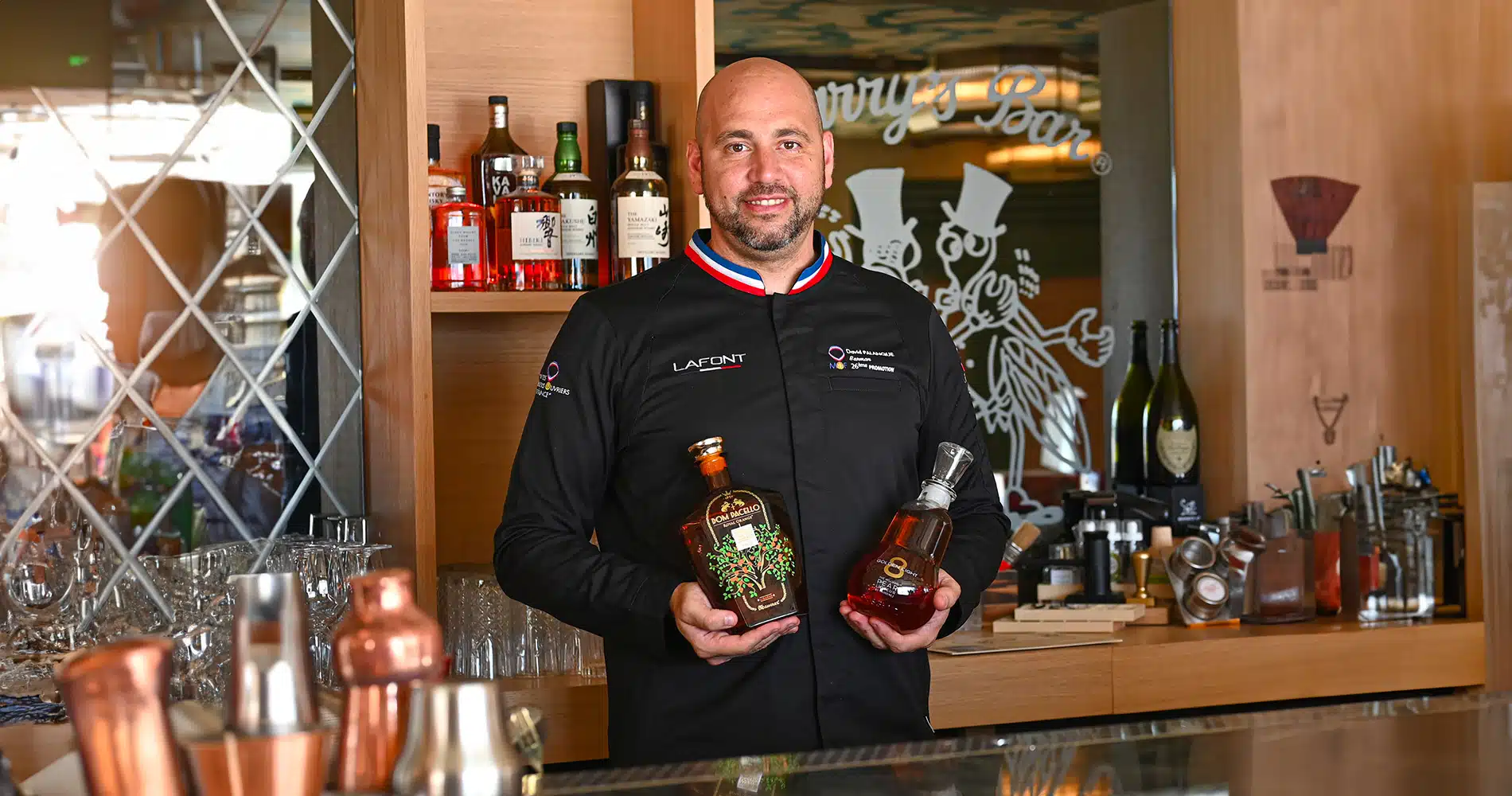
With his blue, white, and red collar, a symbol of one of France’s Best Craftsmen (Meilleur Ouvrier de France), David Palanque could have every reason in the world to be arrogant. Yet, he exudes the complete opposite: inspired, inspiring, passionate about the bar, and committed to training his teams. An encounter with a MOF bartender who truly loves the profession of bartending.
David, tell us about your childhood.
My family moved quite a bit during my childhood as my father was a customs officer and was frequently reassigned. I was born in Strasbourg before moving to the north of France, then I lived in Paris until 2004.
After my sophomore year of high school, I enrolled in a hotel school in Paris, EPMT. That’s where I did my apprenticeship on alternating periods at the bar of the Grand Hôtel Intercontinental in Paris.
I followed that with a year in London before returning to work in Paris, always around the Place de l’Opéra, and later in Port-Royal and then in the south of France. First in Carcassonne, before joining the French Riviera in 2007.
When did you want to become a bartender?
It was a bit by chance, 26 years ago: I wanted to step away from the traditional school curriculum to pursue a career. My mother knew the assistant bar manager at the Grand Hôtel who had offered me an apprenticeship. I had never been to the grand Parisian hotels: I was quite shy and impressed by all that majesty. I didn’t know anything, but they gave me a chance. I completed those two years of apprenticeship, which allowed me to truly discover this world, this profession, and the cocktail culture.
With my first tips, I went to Harry’s bar to buy myself the ABC of mixing Cocktails. Going to London afterwards and learning about other cocktails that perhaps weren’t commonly made in France at the time really decided me to pursue this path.
It’s funny when I look at the evolution since I started: when I did my bar school in London and returned to France, out of the 350 cocktails I had learned, I could only make about a hundred, because the ingredients were still hard to find in France.
How do you assess the cocktail scene in France?
When a consumer orders a classic cocktail, it always remains complicated: a customer will go to several bars and will not find consistency from one establishment to another. Customers will ask for mojitos: in some bars, they will be made with agricultural rum. When they come to us, we make it with Cuban rum, the classic, the original, so they sometimes feel that the rum is not strong enough.
Whereas internationally, especially having worked in London or the United States, I find it more straightforward. A classic is a classic. Not 30,000 recipes. In France, we offer twisted classics everywhere, but without necessarily specifying that it is twisted. Unfortunately, this blurs the lines for the consumer.
How has your job as a bartender evolved in 26 years?
It has completely evolved, but there is only one thing that has not changed for me: advising the client well while remaining precise and fast.
What has completely changed today are the new techniques and the importance of preparation in establishments: preparations, pre-mixes… At the time, this was not done: the bar was linked to the charisma of the bartender, or the bar manager, who would take you into that atmosphere and you would ask for a classic. So, automatically, they had to know it. Creation happened around the relationship with the client: there was a client, she really liked banana. We would create a cocktail for her and give it her first name as the cocktail’s name. And the client was happy, it created a tailor-made experience for them.
Nowadays, bartenders, certain bartenders are more in their own bubble with their preparation, and all the technical aspects. They forget about customer relations, the welcome, and the service that makes the customer feel at ease.
In our establishment, we focus on quality in the glass, with impeccable service. But on the side too, customers like to be recognized and have their tailor-made experience.
It’s not by explaining techniques that are incomprehensible and a bit too advanced for them that they will feel good in your establishment. Moreover, we see that the industry is returning to this: in bartender competitions, there are increasingly people on the juries who don’t necessarily know the bar world, to have an “ordinary” palate.
We must not forget that most of our clientele are ordinary people who come to discover and have an experience. They are happy because they have drunk cocktails that pleased them and allowed them to discover new flavors. We must not forget that when you go to a bar, it’s to feel good, to have an exceptional moment in a magnificent place and setting.
Today, you are the bar manager at Harry’s Bar in Cannes. Are you still often behind the bar?
I now let my team be behind the bar 90-95% of the time. I handle the creation of the menus, in collaboration with the team. If I go behind the bar, firstly, I see fewer customers and I can’t welcome them. Secondly, it’s important for the young people to be behind the bar, because if they only work in the dining room, they lose their motivation, and that’s how a profession dies.
There is currently a crisis with bartenders leaving the profession quite quickly… What is your secret to staying in it for so long?
It’s a very difficult profession. It’s hard physically and psychologically, and we also have complicated evening hours.
Some people leave the cocktail scene and choose to work day shifts: a bar during the day, apart from making soft drinks, teas, and coffees, isn’t the most exciting. But for comfort or due to family life constraints, some prefer this lifestyle, which I respect.
Unfortunately, I can’t understand bartenders who have worked for 2 or 3 years in France or abroad, sometimes not even that, and then return as consultants or brand ambassadors, giving the impression they’ve been in the profession for 40 years. I worked in grand hotels in Paris, where bartenders stayed 20, 30, 40 years in the establishment until retirement. They were all ready to die on stage, or almost. Today, the managers and F&B directors of luxury hotels are killing the passion that existed in these establishments: they change every two years, put immense pressure on staff with emails, meetings, excessive hours, wanting to change and revolutionize everything, only to ultimately achieve nothing. They drain the teams as much as possible, so eventually, even I got fed up with it all…
In addition to my main job, I occasionally do this for brands at events, and I can assure you it’s not the same at all: it’s a different profession. The bar, the most important thing, remains the customer. In these commercial roles, you no longer have contact with the customer, so I believe you can’t say you’re passionate about the bar if you no longer interact with customers!
My goal is for the customer to have a good time in my establishment. That’s where I find pleasure and happiness. I’m not criticizing ambassadors: I work with Massenez because I like their products. But it’s mainly the human connection with them that I find great, and for which I truly find pleasure.
This parallel world also allows for meeting people and staying connected with professionals in the industry.
Bartending is a profession where one can earn a comfortable living. Even if the salaries aren’t extraordinary, one can receive tips and bring joy to others. For example, last night, we were slammed with a full terrace. We ran around like crazy. Everything went well; no one had to wait. In the end, I felt great and was happy. We all said, ‘We had a fantastic evening.’ But the fact that I pleased others, saw them enjoying their drinks, chatting, feeling good, and that it was evident, I love it.
Do you have an anecdote to share with us?
I have a ton of anecdotes. In Paris, when I arrived very early for setup, I sometimes served a “Renard” (a type of drink or a nickname for a regular customer). A regular customer had already entered the bar before opening; I hadn’t even seen him sitting between tables still lowered on the armchairs. Then I heard a voice call out to me, ‘Daviiid, a Riiiicardd.’ Responsible but not guilty… Sometimes, I would even turn off the TV when I got home because everyone I saw reminded me of my customers from the bar all day. At the Martinez, I had the chance to make Martinis for Pierre Brossmann and Jane Fonda. Jamiroquai once lent me his hat to take photos with him. Especially in Cannes, at the Martinez, with the festival, we were truly at the heart of the scene. I had Christophe Rocancourt at the bar asking me questions to try and extract information about certain people. Steve Lukather from the band Toto invited me and my family to their concert in Carcassonne. What an intense moment before joining them at the hotel bar after the concert.
Let’s go back a bit to your MOF Bartender title…
The MOF, to tell the truth, I didn’t really know what it was when I started. I knew there was a big questionnaire, and I thought it could be accessible by revising well. It was a period where I had done quite a few competitions and was even starting to be part of the jury. Competitions, at first I didn’t like them, but by forcing myself, I met people, it helped me evolve and even question myself. So I thought, the MOF, why not? It’s what I’ve always done, it’s my job, I spend most of my time at work, I’m interested in spirits, cocktails, classics, and I had good training, I worked with people who motivated me. So what do I have to lose other than trying? My goal was just to qualify for the final at first. Once in the final, that’s where it really begins. The people around you and in the profession start to encourage you. It was a difficult time: you cut yourself off from the world for a year or two, because the free time outside of work, you spend it revising. I had started exercising a bit again because physical condition is important for professional success. Nothing is impossible in life if you really give it your all. That’s really the message I try to get across to my team.
How would you describe Harry’s Bar in Cannes? What is it like to have a spin-off of a legendary bar in Cannes?
We are happy because we have brought a new cocktail offering to Cannes, which is outside the luxury hotel, with a relatively correct price, at 16 euros per cocktail on average. The owner’s bet was to develop cocktails in Cannes. We are fortunate to have a good clientele. We are located in an idyllic place, set back from Cannes, on Port Canto, facing the harbor master’s office.
We keep the same DNA as Harry’s Bar Paris, but we adapt to the local clientele. In Paris, customers drink more classic and drier cocktails. In Cannes, we have a more refreshing menu with things that are a bit more visual. We remain in the classic style, but with a touch of modernity, without going too far into too outlandish fantasies.
We also have a Cuban atmosphere through the bar’s architecture. Thanks to our outdoor terrace, customers can smoke cigars, we have Latin Cuban music, all in a warm atmosphere. We have a clientele of connoisseurs, but also people who don’t necessarily know cocktails: they want a coffee and they leave with an Espresso Martini.
It was a winning bet: we have been open for two years, and it’s a hit. We are busy all the time!
What is your favorite cocktail right now?
When I go to Paris, of course, I have the Bloody Mary. In Cannes, it’s the French 75: it’s fresh, it has a little spray of absinthe. For me, it’s truly an extraordinary cocktail.
So, at least, I please others, but I also please myself, with very simple things.
What can we wish for you in the coming year?
I wish that it continues like in recent years: the team feels good, and the customers too.
I also wish for myself to always have this team of motivated young people with me, because it is also thanks to them that I enjoy working there. I know I can trust them. We also have an extraordinary boss and owner (Mr Franz-Arthur MacElhone), I adore him and the whole team too, and we are happy to work for Harry’s! We are very proud to honor such an iconic brand in the bar world!
