
The Bartender, the Forgotten Lever of Major Brands
For years, spirits brands have focused on packaging, innovation, and advertising. What if the real growth engine was found behind the bar?
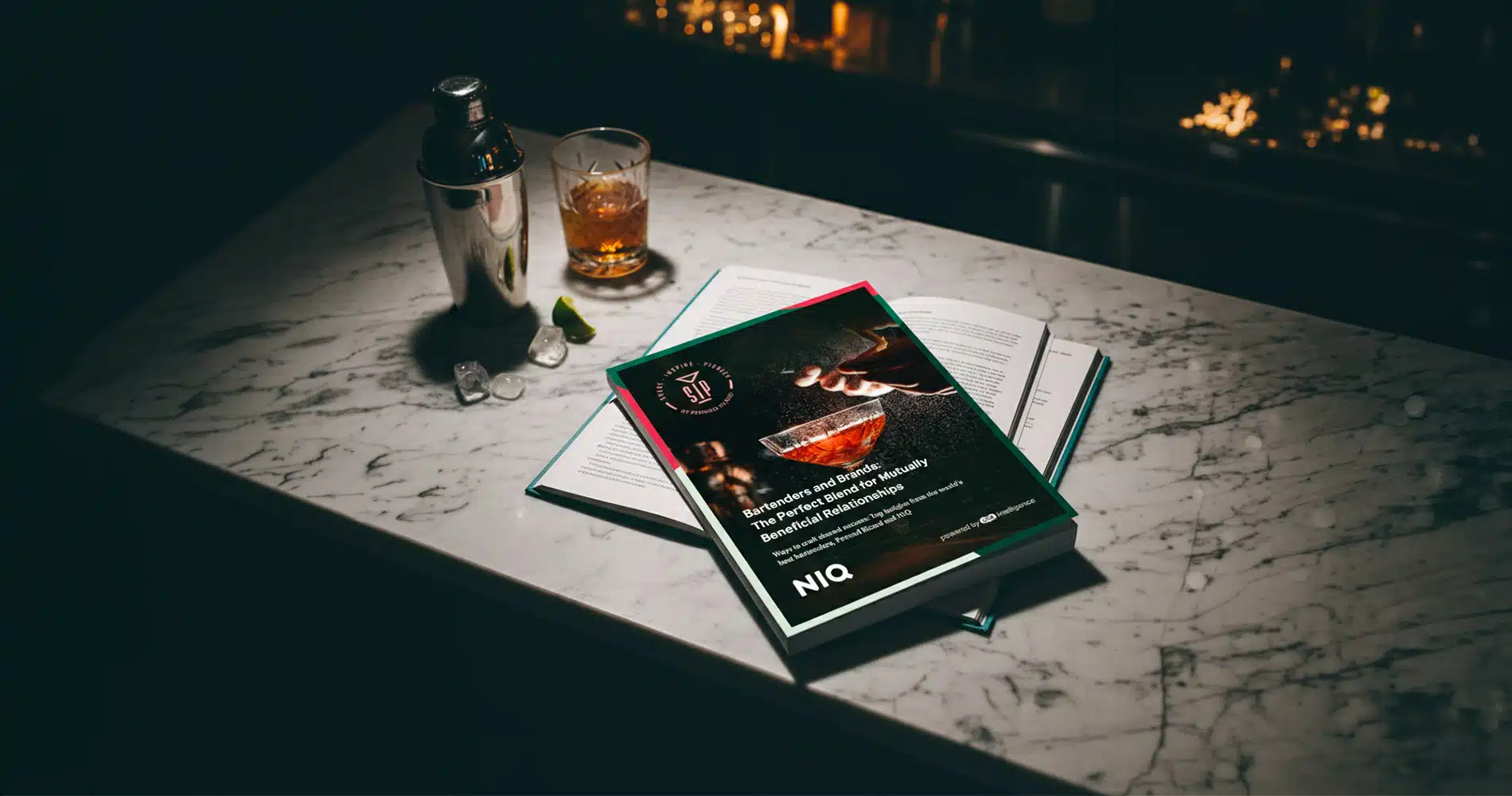
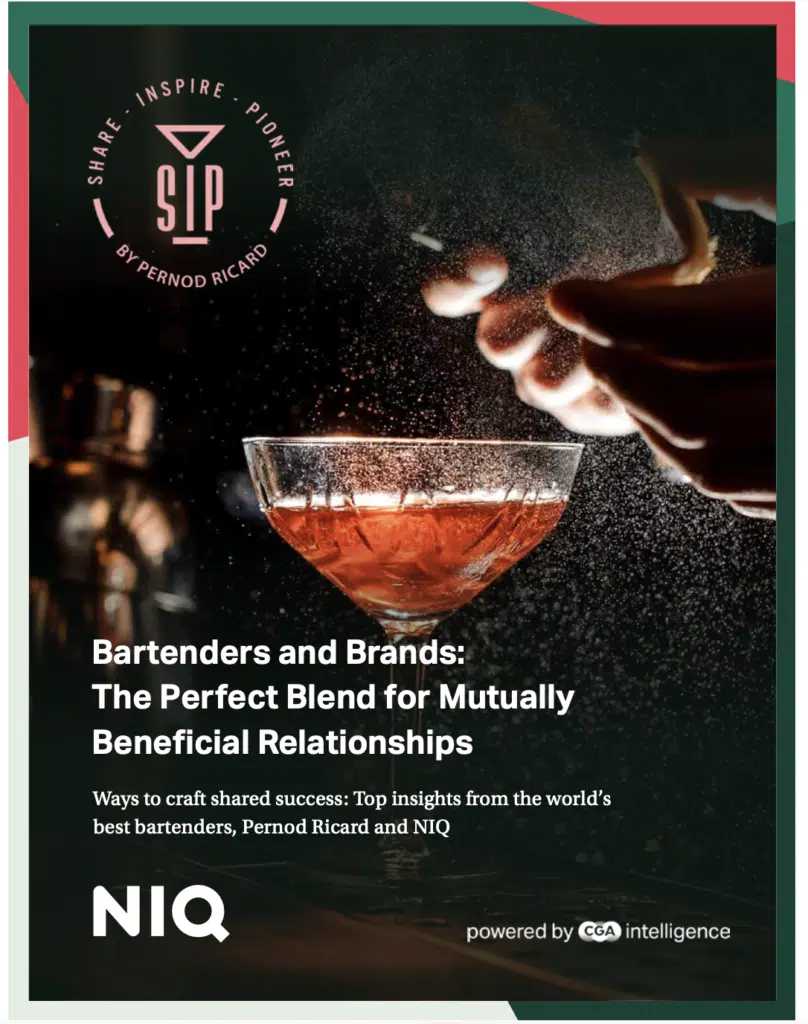
Source: This article is a summary of the report "Bartenders and Brands: The Perfect Blend for Mutually Beneficial Relationships", published in 2026 by NIQ (NielsenIQ, powered by CGA intelligence) in partnership with SIP by Pernod Ricard. It draws on the Global Bartender Report 2026 — an exclusive survey of 1,500 bartenders worldwide — as well as discussions from the "Unlocking Advocacy" panel organized at the Athens Bar Show (10,000 professionals, two days of conferences). Speakers: Danil Nevsky (Indie Bartender), Kate Gerwin (Happy Accidents Bar), Roland Krupinski (Pernod Ricard), Dylan Battick & Charlie Mitchell (NIQ).
10,976
purchase decisions influenced per year by bartender
96%
recommend a brand if they have a good opinion of it
52 %
of customers buy what the bartender recommends
91 %
recommend more after being trained
I. The Virtuous Cycle: When Everyone Wins
There is a moment, in every bar, that lasts only a few seconds but is worth millions. It's when a customer looks at the menu and hesitates. This moment belongs to the bartender. And yet, for decades, spirit brands have sought to influence this moment from the outside (through advertising, bottle design, digital campaigns) rather than addressing directly the person who holds the key.
This is the paradox pointed out in this report published jointly by NIQ and SIP by Pernod Ricard: the most powerful growth lever in the On Premise is not a product innovation, it is a human being. A trained, passionate, influential professional — and often misunderstood by the brands that nevertheless need him.
The study proposes a three-point model. On one side, the brand. On the other, the customer. And in the center, often invisible in marketing strategies, the bartender. These three actors form what the report calls a "virtuous cycle": when they invest in each other, a growth dynamic is triggered that benefits each of them.
Concretely: a brand that trains its bartenders, supports them in their careers, and recognizes their value reaps authentic advocacy in return. A valued bartender naturally recommends the products they love, creates memorable experiences, and fosters customer loyalty. A better-served customer returns, spends more, and becomes an ambassador in turn.
When we help bartenders grow, the entire ecosystem thrives, and our brands grow too. It's a win-win situation where both parties are made for each other.
Roland Krupinski — Head of Sponsorships, Pernod Ricard
The good news is that this model works. The bad news: it's still underutilized. "In the past, brands and bartenders often worked in silos," the report acknowledges, "missing opportunities to mutually amplify their strengths." This era is over, for those who choose to change course.
II. Ten thousand decisions. Per year. Per person.
To understand why bartenders deserve to be at the heart of brand strategies, one only needs to look at the numbers. According to the Global Bartender Report 2026, 88% of bartenders make at least one drink recommendation per shift. Scaled to a full year, that's nearly 11,000 purchasing decisions influenced by a single individual.
But bartenders' influence doesn't stop at the bar. Via Instagram and TikTok, they shape their followers' desires even before they step foot in a bar. Approximately 19% of consumers cite industry professional accounts as a direct source of influence in their drink choices.
And they influence their peers too: 95% of them say they are willing to recommend a brand to their colleagues if their experience with it is positive. In an industry where reputation is built on word-of-mouth, this is invaluable capital.
Bartenders don't just see trends in the On Premise — they create them. When consumers go out, they are looking for experiences they can't replicate at home. This makes the bartender even more important in the eyes of brands.
Dylan Battick — Research Manager, NIQ
Added to this is a third, less obvious but equally valuable dimension: the bartender is an incomparable trend sensor. Present daily with customers, they perceive before anyone else what resonates and what doesn't. Among those surveyed, 85% say they are willing to share their feedback on products they appreciate. Ignoring this source of feedback means ignoring a major strategic advantage.
III. What Bartenders Really Want
Because the brand-bartender relationship is bidirectional, the study also explores what professionals expect from partnerships. The response is more nuanced (and more demanding) than many brands imagine.
1. Contribute to the bar's commercial success
93% of bartenders say that supplier relationships are important for their establishment's performance. Supporting a team's skills directly supports their revenue.
2. Elevate skill levels
Masterclasses, competitions, and certifications are not gimmicks — they are real drivers of development. Partnerships that work give bartenders the freedom to experiment, innovate, and co-create. Those that don't treat them as mere executors.
3. Open career doors
A partnership with a respected brand is also a signal of credibility sent to the entire profession. The study reveals that bartenders involved in brand programs are 57% less likely to encounter difficulties in their professional advancement.
4. Create connection and community
50% of bartenders participate in at least one professional event every three months, and 67% plan to increase their participation in the coming year. Events are not just opportunities to learn; they are spaces for human connection, essential for the development of an often isolating profession.
5. Taking care of well-being
This is the most urgent and most neglected point. 62% of bartenders report facing significant well-being challenges. Long hours, constant pressure, irregular schedules: the conditions are tough. Result: 72% have considered leaving the industry, or have already done so.
84% of bartenders would like to benefit from well-being support. Only 19% believe that suppliers are doing enough in this area.
Global Bartender Report 2026 — NIQ
Brands that act concretely — mentoring, risk reduction training, health initiatives — don't just do good. They radically differentiate themselves in an environment where talk is abundant and actions are rare.
IV. Training: the secret weapon for retention
One of the most striking results of the report concerns the direct link between training and recommendation. The data is conclusive:
- 86% of bartenders have a better relationship with the brands that have supported them through training.
- 91% are more inclined to recommend a brand learned through training.
- 55 % recommend a brand after a positive experience at one of its events.
The preferred training for bartenders? Hands-on workshops, grounded in real-world practice. Certifications and formal programs come next. But the most effective format is often the most informal: peer-to-peer sharing, during events or competitions.
A crucial point: with 9 professional events per year on average, bartenders are overwhelmed with invitations. To capture their attention, an event must offer clear added value, a tangible career benefit, something unobtainable elsewhere. A "one-size-fits-all" format is no longer sufficient.
Education goes beyond product knowledge — it's empowerment. What makes SIP unique is that we put industry leaders directly in front of the next generation of bartenders who want to learn and push boundaries.
Roland Krupinski — Pernod Ricard
Another often underestimated point: training should not be limited to products or mixology. Team management, bar operations, legal skills — these skills don't directly sell a particular spirit, but they create lasting recognition for the brand that helped a professional grow beyond their bar.
V. Beyond the transaction: the true meaning of a partnership
The report points out a common pitfall in the industry: too many engagement programs are designed as short-term commercial projects. One-off gifts, ephemeral activations, financial incentives. These "transactional" relationships have a fundamental flaw: they collapse as soon as conditions change.
Conversely, when a brand builds a relationship based on shared values and genuine authenticity, it creates something entirely different. The study reveals that 50% of bartenders consider value alignment a decisive criterion when choosing their favorite brands. When a bartender identifies with a brand's ethics, advocacy becomes natural—it's not performative, it's sincere.
Your values must align. I'm not talking about generic corporate values like "the customer comes first"—but about your style and your behavior. If you're seen working for a brand that doesn't align with you, people will think you're doing it for the money. And that's a reputation killer.
Danil Nevsky — Founder, Indie Bartender
The ideal formula, according to Roland Krupinski, combines short-term reactivity with a long-term vision: ensuring an initiative works now, while building a consistent presence and credibility that establishes itself over time. "True advocacy cannot be bought. It must be built."
VI. Breaking out of the bubble: where are the real growth drivers?
The study invites brands not to remain confined to the « bubble » of the trendiest bars and most famous bartenders. While the Athens Bar Show celebrates global excellence, the report highlights that the most powerful growth drivers are often found elsewhere.
Cocktail culture is no longer the exclusive domain of a few metropolises. In Africa, South America, and Asia, a new generation of independent bars is emerging, driven by talented bartenders eager for partnerships and capable of generating considerable volumes. However, their access to brand engagement often remains limited, delegated to distributors whose role is more logistical than emotional.
In secondary markets, brands cannot focus solely on bars. Representation is left to the distributor, who knows less about the brand than the bartender themselves and manages a large portfolio with other priorities.
Kate Gerwin — Owner, Happy Accidents Bar
The recommendation is clear: invest in training and alignment at the distributor level, so that brand values travel well beyond internal teams. And broaden the circle of engaged bartenders — because « star-tenders » represent only a tiny fraction of actual sales and tomorrow's trends.
VII. The Seven-Step Guide to Successful Collaboration
Based on all this data and the discussions from the Athens Bar Show, NIQ and SIP by Pernod Ricard distill seven concrete action principles.
1 — Maximize the Power of Engagement
Treat the bartender relationship as a strategic priority, not an ancillary budget item. The impact is direct, massive, and measurable.
2 — Build skills, careers, and communities
Offer holistic programs that cover both soft skills and technical mastery, and address the long-term aspirations of professionals.
3 — Think long-term
Move beyond transactional logic. Authentic and lasting connections always pay off: for bartenders, brands, and customers.
4 — Recognize that well-being generates advocacy
Brands that care for bartenders reap deep and sincere loyalty. This isn't philanthropy, it's smart business.
5 — Create unmissable events
In the face of invitation saturation, offer formats with real added value: identifiable career benefit, unique experience, exclusive content.
6 — Gain online influence
Rely on bartenders as credible voices on social media, not just as simple showcases. Authenticity is the non-negotiable condition.
7 — Step out of the bubble
Explore emerging markets and secondary cities. Go beyond the "star-tenders" to reach the real volume drivers, and the trends of tomorrow.
The perfect blend is not in the recipe: it is in the relationship!
This report from NIQ and SIP by Pernod Ricard demonstrates this with remarkable clarity: the bartender is not a passive intermediary between a bottle and a glass. They are the living heart of the On Premise experience, the architect of the moments that make a customer return... or not.
Brands that have understood this are no longer trying to seduce bartenders with ephemeral benefits. They are investing in their growth, respecting their values, and building lasting partnerships with them. In doing so, they are not only doing good for the industry — they are securing a sustainable competitive advantage.
The virtuous cycle is not a utopia. It is a proven mechanism. And it starts behind a bar.
Full source: "Bartenders and Brands — The Perfect Blend for Mutually Beneficial Relationships", NIQ (NielsenIQ, powered by CGA intelligence) & SIP by Pernod Ricard, 2026. Global Bartender Report 2026 Survey, n = 1,500 bartenders. More information on niq.com and join-sip.com.
